
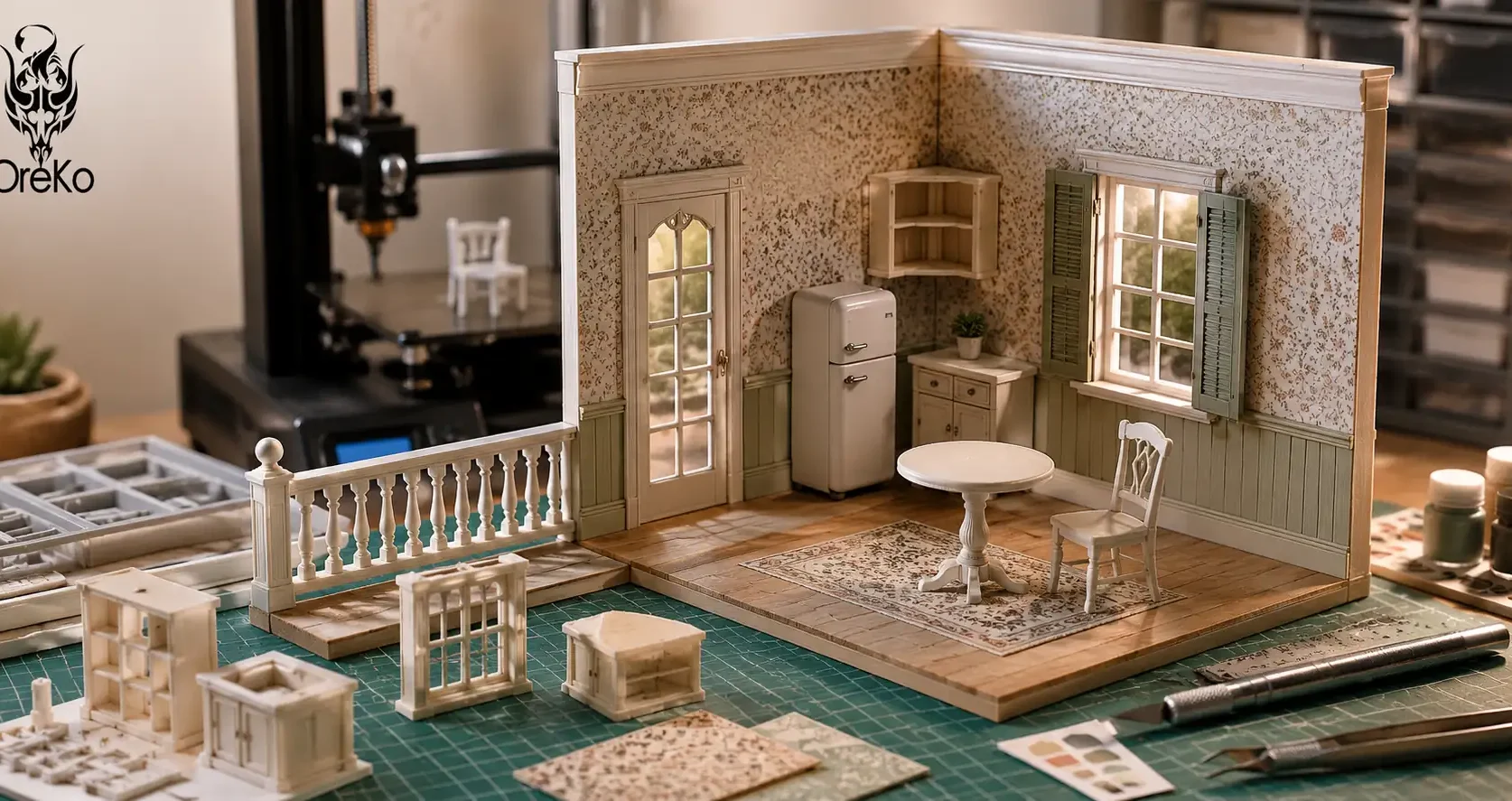
Building a complete 1:12 scale room with 3D printed parts is one of the most satisfying projects in the dollhouse hobby. Every element can be customised, printed to exact dimensions, and designed to fit your specific space. This guide walks through the full process from planning to finished room, with specific attention to how 3D printed components integrate with traditional dollhouse materials and how to use the OreKo catalog efficiently within a room build.
Understanding 1:12 Scale
Every dimension in a 1:12 scale dollhouse is exactly 1/12th of real life. A standard interior door is 2,032mm (80 inches) tall in real life, so the 1:12 version is 169mm. A kitchen counter height of 914mm becomes 76mm. A dinner plate with a real diameter of 250mm becomes 21mm in scale.
Working in 1:12 requires converting every real dimension before printing. The formula is simple: real measurement in mm divided by 12 equals the scale measurement. A standard UK brick (215 x 102.5 x 65mm) becomes 17.9 x 8.5 x 5.4mm. Working precisely to scale is what makes a finished room look right rather than approximately right.
More detail on 1:12 scale conventions, furniture standards, and room planning is in the dedicated 1:12 scale guide.
Planning the Room: What to Print vs What to Buy
A typical 1:12 room build combines 3D printed components with commercially sourced materials for wallpaper, flooring, fabric, and finishing details. Here’s how to think about the division:
| Element | 3D Print | Buy or Source Elsewhere |
|---|---|---|
| Architectural trim (window surrounds, balcony railings, mouldings) | Excellent fit. Prints to exact dimensions. | |
| Furniture (tables, chairs, sofas, beds) | Good for rigid furniture, appliances. | Upholstered items often better sourced or fabric-wrapped after printing. |
| Appliances (fridge, stove, washer) | Ideal. Accurate dimensions, hard to find commercially at scale. | |
| Windows and shutters | Excellent. Working shutters possible with 3D printing. | |
| Flooring | Possible but long print time for large areas. Texture tiles work well. | Commercial 1:12 flooring sheets or printed paper flooring is often faster. |
| Wallpaper and wall finish | Not practical for large walls. | Printed paper wallpaper or commercial miniature wallpaper sheets. |
| Small decorative accessories (vases, books, plants) | Excellent. Custom scale, unlimited variety. |
Building Around the OreKo Catalog
OreKo’s 1:12 scale models cover several key architectural and appliance elements that form natural anchors for a room build:
- The side-by-side refrigerator (1:12 with opening doors) anchors a kitchen or utility room. Print in white or light grey PLA, finish with gloss paint and satin varnish for a convincing appliance surface.
- The balcony railing set (4,900+ views on Cults3D, 44 purchases) is the most popular OreKo model for good reason. It prints clean at 1:12 scale in multiple style variants and fits any Victorian, Georgian, or classical room with an outdoor element or landing.
- The miniature windows with working shutters are architectural set pieces that establish period and style. Three design variants give flexibility across different room styles.
- The window with shutters and planter adds exterior character and works equally well as a room detail in a garden room or kitchen.
Use these as the structural elements of your room plan and build decorative accessories around them. The consistent scale across all OreKo models means everything fits together without manual size corrections.
Print Settings for Dollhouse Room Components
1:12 scale work requires the finest practical settings to preserve the detail that makes the pieces look right:
| Component Type | Layer Height | Walls | Infill | Notes |
|---|---|---|---|---|
| Architectural trim (railings, window frames) | 0.12mm | 3-4 | 20% | Fine detail requires fine layers. Worth the time. |
| Furniture (chairs, tables) | 0.12-0.16mm | 3 | 15% | 0.16mm gives a good quality-to-time balance for medium furniture. |
| Large appliances (fridge) | 0.2mm | 3 | 10-15% | Flat surfaces look fine at 0.2mm. Faster print time acceptable. |
| Small accessories (vases, decorations) | 0.08-0.12mm | 3-4 | 15-20% | Very fine layer height justified for tiny decorative items. |
More on how layer height affects miniature quality at the layer height guide and the specific best layer height for miniatures post.
Assembly and Installation Order
Building a room in the right sequence prevents access problems and rework. The general order:
- Complete and finish architectural elements first: walls, floors, and ceiling treatment before furniture goes in
- Install fixed architectural 3D printed elements: window surrounds, mouldings, railings. These are hardest to access once furniture is in place
- Place large furniture: appliances, beds, sofas. Test positions before gluing permanently
- Add medium furniture: tables, chairs, shelving units
- Install windows and shutters: the miniature windows with working shutters slot in after the wall treatment is in place
- Add small accessories last: vases, books, plants, tableware. These fill the visual space and can be repositioned freely
Frequently Asked Questions: 1:12 Scale Dollhouse Room Build
What scale is 1:12 for a dollhouse?
1:12 means every measurement is 1/12th of real life. One inch in the model equals one foot in real life. A 6-foot (1,829mm) tall person would be exactly 152mm (6 inches) tall in a 1:12 scale room. It’s the most common dollhouse scale and the one most commercially available furniture and accessories are built to.
Can you 3D print an entire dollhouse room?
You can print all the rigid furniture, architectural trim, appliances, and decorative accessories. Wall and floor treatments are usually more practical as printed paper, fabric, or commercial miniature sheet materials. A fully 3D printed room is achievable but represents many hours of print time. Most builders combine printed elements with commercial miniature supplies for the best result.
What is the best 3D printer for 1:12 scale dollhouse parts?
Any well-tuned FDM printer printing at 0.12mm layer height produces good results for 1:12 scale furniture. Bambu Lab printers with their part cooling and speed produce particularly clean 0.12mm layers. Resin printers produce even finer detail for very small accessories but require the post-processing workflow and can’t produce the larger pieces that FDM handles easily.
How do you make 3D printed dollhouse furniture look realistic?
Printing in matte PLA at 0.12mm layer height, followed by primer, painting with techniques like wood grain effects and washes, and sealing with matte or satin varnish produces realistic-looking miniature furniture. Scale is also important: pieces built to exact 1:12 dimensions look right; slightly off-scale pieces register as wrong even to viewers who can’t articulate why.