
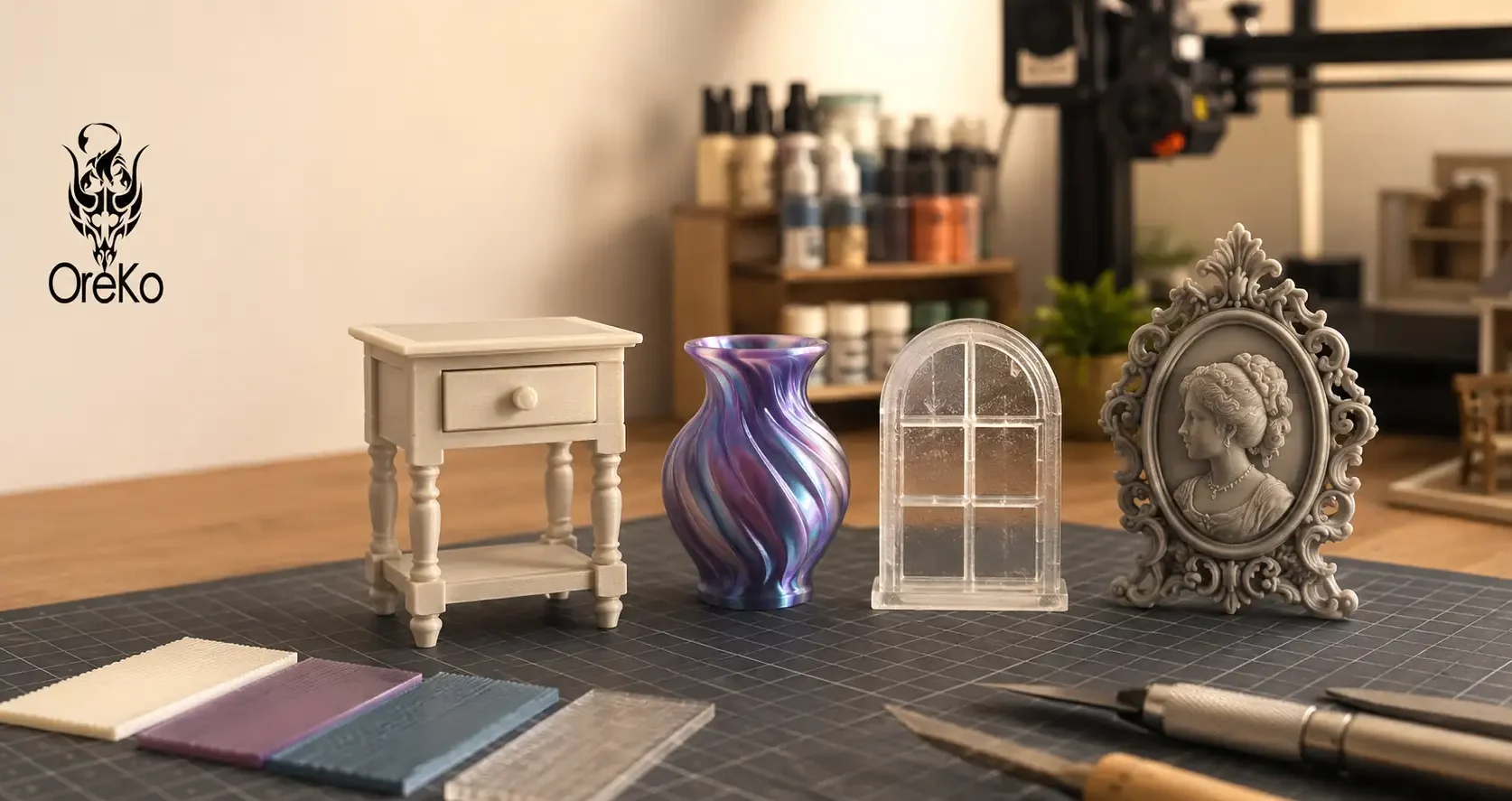
Filament choice for dollhouse miniatures is different from filament choice for functional parts or cosplay props. At 1:12 scale, surface finish is everything. Details are tiny. The difference between a miniature that looks like a real object and one that reads as plastic often comes down to which filament you used and whether it was right for the piece. Here’s the breakdown of every relevant option with honest recommendations for each type of dollhouse component.
The Core Requirement: Detail Resolution and Surface Quality
Dollhouse miniatures need filament that holds fine detail, produces clean surfaces at 0.12mm layer height, and gives a finish that can either stand on its own or accept paint well. Mechanical properties like strength and heat resistance are mostly irrelevant for display pieces that live on a shelf.
The two properties that actually matter for miniatures:
- Surface quality at fine layer heights: How clean does the material look at 0.12mm layers? Does it hold sharp edges and fine features without stringing or surface roughness?
- Finish appearance: Does the printed surface look like a material (wood, ceramic, fabric) after painting, or does it read as plastic regardless of paint?
Filament Comparison for Dollhouse Miniatures
| Filament | Surface at 0.12mm | Paintability | Unpainted Appearance | Best For |
|---|---|---|---|---|
| Matte PLA | Excellent. Clean, takes fine detail well. | Best. Primer bonds immediately. | Flat, material-like. Good for wood and stone effects. | All painted furniture. Default choice. |
| Silk PLA | Excellent. Particularly clean at fine layer heights. | Difficult without sanding first. | Shiny, jewel-like. Looks like ceramic, glass, or metal unpainted. | Decorative accessories, vases, gems, metallic fixtures. |
| Standard PLA | Good. Slight sheen at fine layers. | Good with sanding, moderate without. | Plastic appearance. Reads as generic. | Acceptable where matte isn’t available. |
| PETG | Good but more prone to stringing on fine features. | Moderate. Harder to sand than PLA. | Slight translucency can work for glass effects. | Miniature glass-effect pieces (windows, bottles) in clear PETG. |
| Resin (MSLA) | Superior. 0.05mm XY resolution captures details FDM can’t. | Excellent with proper surface prep. | Very smooth. Good for faces, fine textures, jewellery scale work. | Tiny accessories, faces, intricate items under 50mm. |
Matte PLA: Why It’s the Default for Painted Miniatures
Matte PLA is the strongest choice for any dollhouse piece you plan to paint. The textured surface that gives matte PLA its flat appearance is exactly what primer needs to grip. Apply filler primer to a matte PLA print and it bonds immediately and evenly, producing a smooth base for acrylic paint without sanding.
The flat finish of matte PLA also plays a practical visual role after painting. When you apply a wash, dry brushing, or layered colour effects, the underlying matte surface absorbs the technique correctly without the base material fighting the effect. Standard PLA’s slight sheen can make thin paint coats look patchy; matte PLA lets the paint perform as expected.
All OreKo dollhouse models are designed and photographed in eSUN Matte PLA, available in the whites, greys, and creams most useful for dollhouse work. The balcony railing set in white matte PLA and the windows set in grey matte PLA both paint cleanly with standard acrylics and a satin seal.
Silk PLA: For Pieces That Should Look Shiny Unpainted
The 1:12 scale room has elements that should look glossy without painting: ceramic vases, porcelain figurines, glass bottles, metallic fixtures, gems, and decorative glazed pottery. Painting these to look glossy is possible but requires gloss varnish over the top, which can look thick at small scale and obscure fine detail.
Silk PLA in the right colour straight off the printer looks ceramic or metallic at 1:12 scale. Gold silk PLA for a decorative vase, white silk for a porcelain figurine, deep blue silk for a glazed pottery bowl: none of these need paint and the result looks more convincing than the painted alternative for their specific aesthetic.
Use silk PLA strategically for unpainted decorative accessories. Use matte PLA for everything that needs paint. The contrast between the two in a finished room adds visual richness: some pieces read as ceramic, some as painted wood, some as metal, just as a real room would have material variety. More detail on choosing between them is in the PLA for dollhouse furniture guide.
When to Use Resin for Dollhouse Work
FDM at 0.12mm layer height produces excellent results for most dollhouse furniture and architectural elements. Resin printing becomes relevant when you need detail that FDM simply can’t produce: faces on figures, very thin decorative elements, miniature jewellery, or accessories under about 15-20mm where FDM’s minimum feature size starts to limit what’s achievable.
If you have access to both an FDM and a resin printer, the natural division is FDM for larger furniture and architectural pieces (where build volume and print speed matter) and resin for tiny decorative items where detail resolution is the priority. A room built with FDM furniture and resin decorative accessories combines the strengths of both technologies effectively.
For a comparison of the two technologies side by side, the FDM vs resin comparison covers the full trade-off.
Colour Strategy for Dollhouse Miniatures
Print colour affects how much paint work a piece needs and how it looks under different lighting in the finished room.
- White matte PLA: Default for anything being painted a light or mid colour. White primer isn’t needed over white PLA, saving a step.
- Grey matte PLA: Better base for mid-tone and dark painted finishes. More common in OreKo architectural models where grey reads correctly before paint and after.
- Black matte PLA: For ironwork, railings, and fixtures that benefit from dark base tone showing through dry-brushed metallic effects.
- Colour-matched matte PLA: For pieces that won’t be fully painted. Printing a wooden table in a warm tan matte PLA and adding only a subtle wash is faster than printing grey and painting the full base coat.
Browse the filament guide for a broader overview of PLA variants and how to choose between them.
Frequently Asked Questions: Best Filament for Dollhouse Miniatures
What is the best filament for 3D printing dollhouse furniture?
Matte PLA for any piece you plan to paint. Its texture bonds to primer immediately, produces clean surfaces at 0.12mm layer height, and gives a base finish that accepts acrylic paint techniques well. Silk PLA for unpainted decorative accessories where a shiny, ceramic-like appearance is the goal.
Can you print dollhouse furniture in PETG?
Yes but it’s not ideal. PETG is harder to sand than PLA and primer adhesion is lower without mechanical surface prep. For furniture that will be painted, matte PLA produces better results with less effort. PETG is more useful for functional dollhouse elements like hinges or flexible connectors, not for the furniture pieces themselves.
Is resin better than PLA for dollhouse miniatures?
Resin produces finer detail at smaller scales, which matters for tiny accessories, figures, and objects under about 20mm. For furniture, railings, windows, and architectural elements at 1:12 scale, FDM in PLA at 0.12mm layer height is more practical: larger build volume, no post-processing chemicals, and faster print time for pieces of that size. Many dollhouse builders use both technologies together.
What layer height should I use for 1:12 scale miniatures?
0.12mm for fine furniture, architectural trim, and detailed accessories. 0.2mm is acceptable for larger pieces with less surface detail like appliances and flat panels. More detail on this in the dedicated layer height for miniatures guide.
This post contains an affiliate link. If you purchase through it, we earn a small commission at no extra cost to you.