
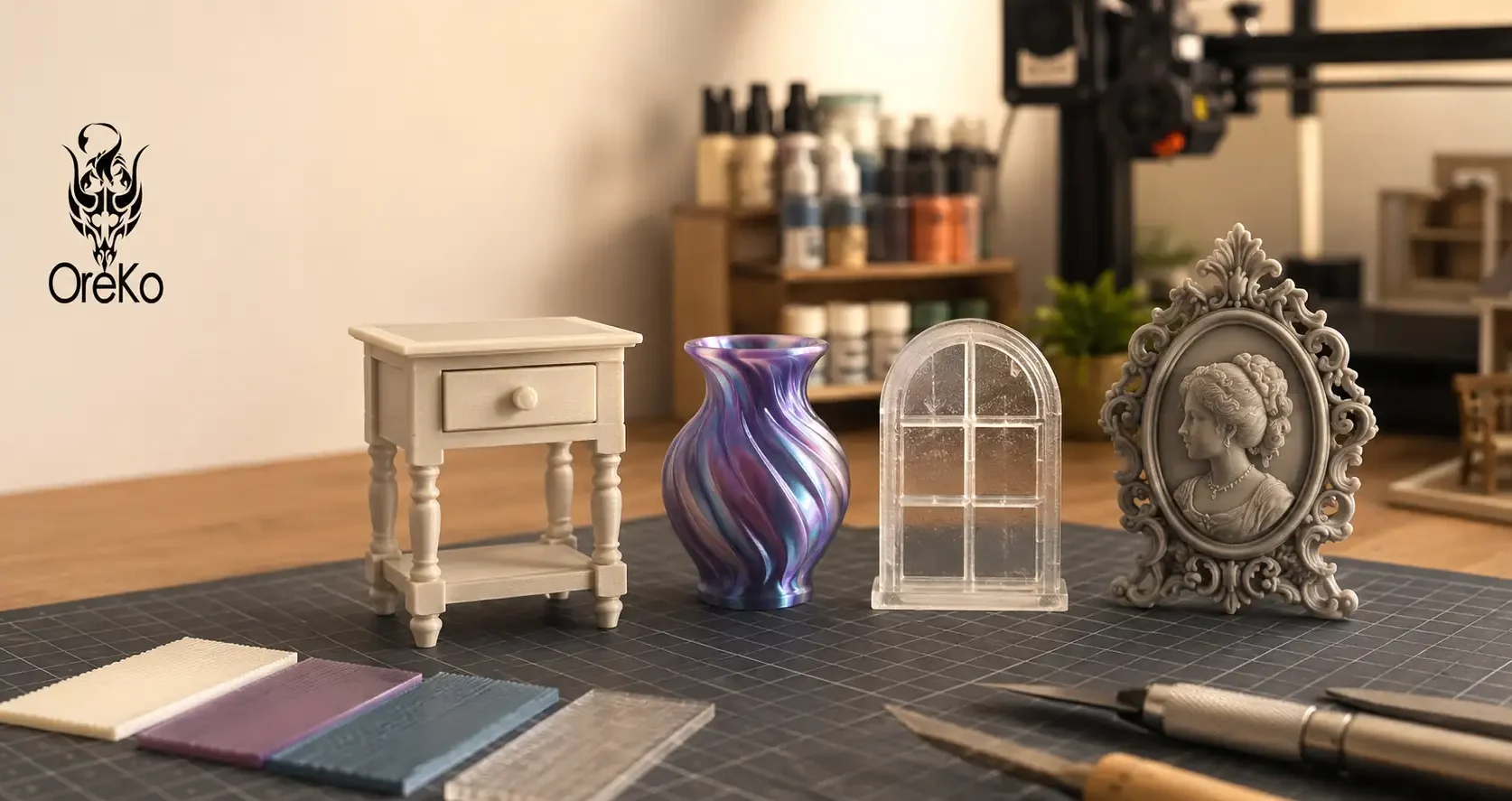
Silk PLA and matte PLA print at the same temperatures, on the same printers, using virtually the same slicer settings. The finished results look completely different. One comes out with a glossy, satin sheen that catches light dramatically. The other comes out flat and textured, taking primer and paint without any preparation. The choice between them depends almost entirely on one question: will this print be painted?
What Makes Silk PLA Different
Silk PLA contains additives that reduce the melt viscosity of the plastic and create a self-leveling effect as it’s deposited. Each layer flows out more smoothly than standard PLA, producing a surface with a high-sheen finish and slight translucency that gives the appearance of depth.
The sheen isn’t a post-print coating. It’s a property of how the material flows during extrusion. When light hits a silk PLA print, it reflects uniformly across the surface the way satin fabric or polished metal does, which is where the name comes from. Gold silk PLA reflects light the way gold leaf does. Copper silk PLA has the warmth of actual copper.
This makes silk PLA excellent for prints you want to display without painting: figurines, decorative objects, jewelry accessories, gems in cosplay builds, and any print where the filament’s own surface finish is the intended final result.
The downsides are mechanical: silk PLA is slightly more brittle than standard PLA, slightly more prone to stringing, and its smooth sheen surface resists primer adhesion without sanding first.
What Makes Matte PLA Different
Matte PLA contains additives that scatter light rather than reflect it, producing a flat, non-reflective surface. The texture created by these additives is microscopically rough, which has a practical consequence: primer and paint bond to matte PLA immediately and securely, without the 220-grit scuff-sanding step that standard PLA requires.
The matte surface also reduces the visible contribution of layer lines compared to standard PLA. Curved surfaces in matte PLA look cleaner at the same layer height because the non-reflective surface doesn’t highlight the ridge structure of individual layers the way a shiny surface does.
This makes matte PLA the clear default for any print you plan to paint, and a strong choice for prints where you want a natural, material-like appearance: furniture, architectural elements, tactical props, anything where plastic-looking gloss would undermine the aesthetic.
Complete Side-by-Side Comparison
| Property | Silk PLA | Matte PLA |
|---|---|---|
| Surface finish | High sheen, satin-like, slight translucency and depth | Flat, non-reflective, chalky texture |
| Paintability | Difficult without sanding. Sheen resists primer adhesion. | Excellent. Primer grips immediately, no surface prep needed. |
| Layer line visibility | More visible — light reflection highlights layer ridges on curves | Less visible — matte texture absorbs layer-line reflections |
| Print temperature | 205-230°C. Slightly higher than standard PLA for best sheen. | 190-220°C. Same range as standard PLA. |
| Stringing tendency | Higher than standard PLA due to lower melt viscosity. Retraction tuning helps. | Comparable to standard PLA. Slightly more than standard on some brands. |
| Mechanical strength | Slightly lower than standard PLA. Additives affect layer bonding slightly. | Comparable to standard PLA. |
| Heat resistance | Slightly lower than standard PLA (~55-60°C). More heat-sensitive. | Standard PLA range (~60°C). Same Florida heat risk. |
| Moisture sensitivity | Similar to standard PLA. Store sealed with desiccant. | Slightly more sensitive. Additives increase absorption rate marginally. |
| Price | $20-$35/kg. Slightly higher than standard PLA. | $18-$30/kg. Similar to standard PLA. |
| Best for | Display prints, figurines, gems, metallic cosplay accessories, AMS multi-material contrast accents | Anything to be painted, cosplay prop bodies, deck boxes, architectural models, functional hobby pieces |
When to Use Silk PLA
Gold and metallic cosplay accessories. Silk gold PLA prints with a metallic luster that eliminates the paint step for decorative trims, crown pieces, jewelry elements, and gem settings. At convention distance the result is convincing. The time saving versus masking and painting gold trim is significant across a full cosplay build.
Decorative figurines and display pieces. A silk PLA figurine in an appropriate color catches light the way a professionally painted piece does, without the post-processing complexity. Display quality without sanding or priming.
Dollhouse accessories with glossy finishes. Chrome fixtures, appliances, and shiny decorative objects in 1:12 scale benefit from silk’s reflective quality. A silk silver refrigerator handle on a matte PLA appliance body looks like actual metal hardware at scale. A silk white ceramic bowl looks like glazed pottery.
AMS multi-material builds. Using silk PLA for gem or metallic elements alongside matte PLA for prop bodies creates natural material contrast within a single print run. An AMS-enabled Bambu Lab printer can print the matte black body of a weapon prop with silk gold trim details and silk blue gem inserts in a single automated print.
Rainbow and gradient silk PLAs. Multi-color silk PLAs shift through color gradients during printing, creating naturally varied color patterns across the print. These are striking on organic shapes, figurines, and display vases where the gradient pattern follows the print geometry. Not suitable for precise color-accurate prints but visually compelling for abstract and decorative work.
When to Use Matte PLA
Anything to be painted. This is matte PLA’s defining advantage. The textured surface bonds to primer without any preparation step. For a cosplay build with 20 pieces all going through prime-and-paint workflow, using matte PLA saves one sanding step per piece — easily 2-3 hours of total prep work across the build. The full case for matte PLA in painted props is covered in the matte filament cosplay guide.
Deck boxes and gaming accessories. A matte finish on a deck box reads as a quality product rather than plastic. The OreKo One Piece and MTG deck boxes are all photographed in matte PLA because the surface quality is consistent, clean, and appropriate for the aesthetic.
Dollhouse furniture and architectural models. Matte white reads as plaster or painted wood. Matte grey reads as concrete or stone. Matte tan reads as wood. These material associations make matte PLA significantly more convincing for architectural-scale work at 1:12.
Prints where layer lines matter. If a print will be displayed at close range and you don’t plan to sand, matte PLA at 0.12-0.16mm layer height produces cleaner curved surfaces than standard PLA at the same layer height because the matte texture absorbs the reflections that make layer lines visible.
Combining Both in One Build
The most sophisticated use of silk and matte together is in AMS multi-material builds where both filaments appear in the same print. The contrast between the two surface types creates a material-differentiation effect that painted single-material prints struggle to match.
Deck box logo caps: The box body in matte black PLA, the logo cap in silk gold. The matte body reads as a hard tactical case. The silk logo reads as an inlaid gold element. No paint required. This is the recommended configuration for the OreKo One Piece deck maker set with AMS.
Armor with trim: Matte armor body with silk metallic trim. Two-color AMS print, zero paint for color separation.
Dollhouse room scenes: Matte PLA furniture bodies, silk PLA metallic fixtures and gems. The material contrast between the flat furniture and the reflective accessories makes the scene look more varied and realistic than a monochrome finish would.
Practical note on AMS with silk: Silk PLA purges cleanly in most Bambu Lab AMS setups. Its lower viscosity means it cleans out of the nozzle faster during color change cycles than standard PLA, which can reduce purge tower waste slightly when running silk as a secondary color.
Brand Recommendations
Silk PLA:
- Bambu Lab Silk PLA: Best sheen consistency. Gold, silver, and copper are the standout metallic colors. Pre-tuned profiles in Bambu Studio.
- eSUN Silk PLA: Wide color range including galaxy, dual-color silk, and standard metallics. Good quality at mid-range price.
- Polymaker PolyLite Silk: Consistent quality, slightly more muted sheen than Bambu Lab. Good for less dramatic metallic finishes.
Matte PLA:
- Bambu Lab PLA Matte: Best-in-class matte surface. Primer bonds without any preparation. Available in prop and dollhouse relevant colors including matte black, grey, white, tan, and gold.
- eSUN Matte PLA: Excellent value, widest color range of any matte PLA brand, consistent spool-to-spool. Used across the OreKo catalog.
- Polymaker PolyTerra: Plant-derived matte additive creates a distinctive earthy, chalky finish. Excellent for architectural models and nature-themed prints.
Printing Tips for Each Material
Silk PLA settings:
Print temperature 210-225°C. The higher end of this range produces better sheen on most brands. Reduce print speed 10-15% below your standard PLA profile to allow the material to flow and level. Reduce part cooling fan to 50-70% on visible surfaces (slower cooling improves sheen quality by letting the material settle). Increase retraction slightly (0.5-0.8mm at 35-45mm/s direct drive, 3-5mm at Bowden) to reduce stringing caused by the lower viscosity melt.
For Bambu Lab machines: the default silk preset is calibrated well. Use it without modification for your first silk print, then adjust if your specific brand of silk runs differently.
Matte PLA settings:
Print at standard PLA temperatures (200-215°C for most brands). Full part cooling produces the best matte texture. Matte PLA benefits from slightly higher fan speed than standard PLA, not lower. Retraction is similar to standard PLA. The Bambu Lab matte PLA preset is accurate for both Bambu Lab brand and most third-party matte PLAs.
Store matte PLA sealed with desiccant. The additives that create the matte texture can be slightly more moisture-sensitive than standard PLA, producing subtle surface roughness when wet. Dry at 45-50°C for 4-6 hours if matte filament has been left open in Florida summer humidity.
Frequently Asked Questions: Silk PLA vs Matte PLA
Is silk PLA stronger than matte PLA?
No. Silk PLA is slightly weaker than standard PLA in most tensile testing because its additives affect layer bonding. Matte PLA is broadly comparable to standard PLA in mechanical properties. For strength-critical applications, neither is the right choice. PETG outperforms both.
Can you paint silk PLA?
Yes, but with more preparation than matte PLA. Silk’s sheen surface resists primer adhesion without mechanical scuffing. Sand with 220 grit across the entire surface, clean with IPA, then prime normally. For any print you know will be painted, matte PLA is significantly easier and produces a better result.
Does silk PLA print differently from standard PLA?
Slightly. Best results at 5-15°C higher than standard PLA (210-225°C vs 200-215°C). Strings more due to lower melt viscosity, so retraction benefits from tuning. Print speed 10-15% slower than standard PLA. Reduced fan cooling improves sheen quality on display surfaces. Most slicers include silk PLA presets.
What is the best silk PLA for metallic effects?
Bambu Lab Silk PLA in gold and silver lead the field for sheen quality. eSUN Silk, Polymaker PolyLite Silk, and 3DFuel Workday Silk are strong alternatives. Multi-color silk blends (dual-color silk, galaxy silk) create gradient effects that are striking on organic and decorative shapes.
Which looks better unpainted: silk or matte?
Depends on the object. Silk looks better for anything that should appear shiny, metallic, or jewel-like. Matte looks better for anything that should read as a material — fabric, stone, concrete, painted metal — rather than plastic. The choice is aesthetic, not technical.
Can you mix silk and matte in the same AMS print?
Yes. This is one of the most effective uses of a multi-color AMS setup. The contrast between silk and matte surfaces in the same print creates a material-differentiation effect that looks intentionally designed rather than accidentally varied. Deck box bodies in matte with logo caps in silk is the OreKo recommendation for the One Piece and MTG deck maker sets.
Does matte PLA hide layer lines better than standard PLA?
Yes, to a meaningful degree. The matte texture absorbs the light reflections that make layer-line ridges visible on curved surfaces. At the same layer height, matte PLA curved surfaces look cleaner than standard PLA without any sanding. At fine layer heights (0.12mm), the difference is subtle. At standard 0.2mm, the difference is clearly visible.