
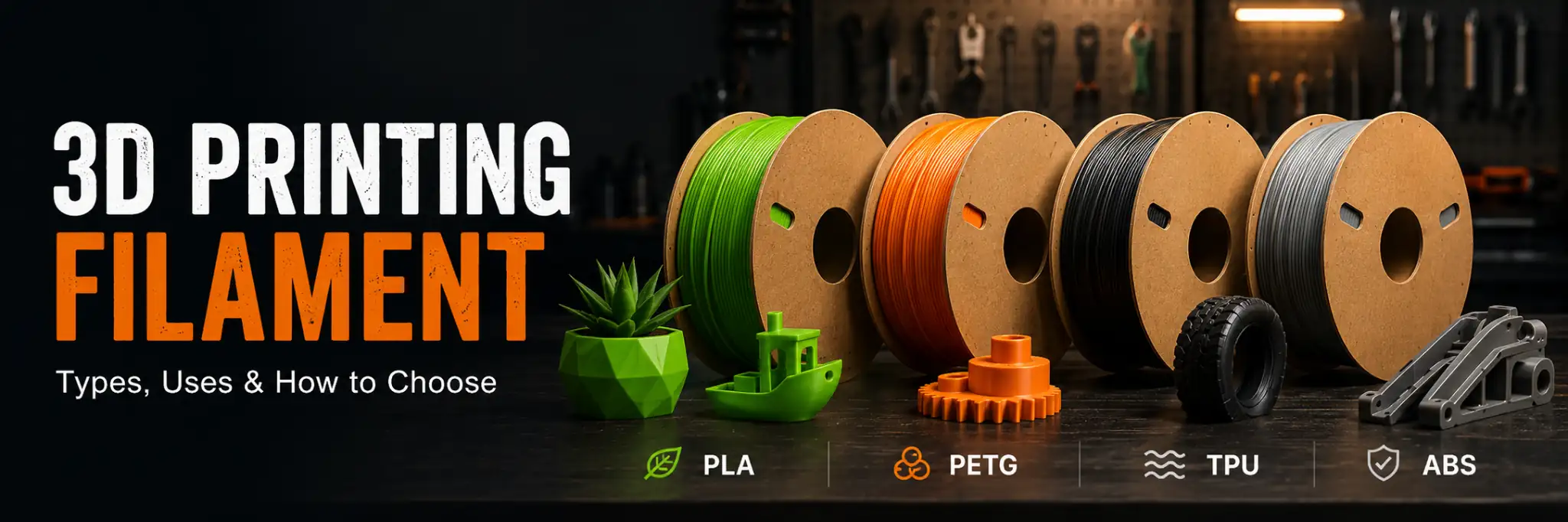
Filament is the raw material of FDM 3D printing. The type you choose affects every aspect of the print: how it looks, how strong it is, how it behaves on the printer, and whether it can be painted.
PLA
Plant-based, easy to print, and available in standard, matte, silk, and specialty finishes. The right material for most hobbyist and decorative applications.
Full PLA Guide
PETG
Tougher and more heat-resistant than PLA. No enclosure needed. The go-to for functional parts that see stress, moderate heat, or humidity.
Full PETG Guide
ABS / ASA
High-heat engineering filaments that require an enclosure. ABS for acetone smoothing. ASA for UV-resistant outdoor prints.
ABS and ASA Guide
TPU
Flexible, rubber-like filament for phone cases, gaskets, grips, and living hinges. Needs a direct drive extruder to print reliably.
Full TPU Guide
What Is 3D Printing Filament?
Filament is the plastic feedstock used in FDM 3D printing. It comes on spools in standardised diameters — 1.75mm is the standard for virtually all consumer printers. The filament feeds into the printer’s hot end, melts at a controlled temperature, and gets deposited layer by layer to build the object.
The type of plastic determines the printing temperature, bed temperature, mechanical properties, and finishing characteristics of the finished print. Choosing the right filament for the job is one of the most important decisions in producing a good result.
The Main Filament Types
PLA
The most beginner-friendly filament. Plant-based, easy to print, available in hundreds of colours including matte, silk, and metallic finishes. Best for decorative objects, display pieces, miniatures, and most hobbyist applications. Prints at 190-220°C. No heated bed required.
Use for: OreKo deck boxes, dollhouse miniatures, display pieces
PETG
More flexible and impact-resistant than PLA. Better heat resistance (up to ~80°C vs PLA’s ~60°C). Slightly more prone to stringing but excellent for functional parts. Good transparency options. Prints at 230-250°C.
Use for: Parts that flex, functional brackets, items exposed to moderate heat, Lollipop Chainsaw chain pins
ABS / ASA
The original hobbyist engineering filament. Strong, heat-resistant, and sandable. Requires an enclosed printer and a heated bed at 100°C+ to prevent warping. Emits fumes — ventilation required. Has largely been replaced by ASA and PETG for most applications.
Use for: Acetone vapour smoothing, high-heat environments, UV-resistant outdoor prints
TPU
Flexible filament. Rubber-like properties with varying Shore hardness depending on formulation. Excellent for phone cases, gaskets, flexible joints, and wearables. Requires a direct drive extruder for reliable printing. Prints slowly.
Use for: Flexible parts, protective cases, gaskets, grips
PLA Finishes: Matte, Silk, and Standard
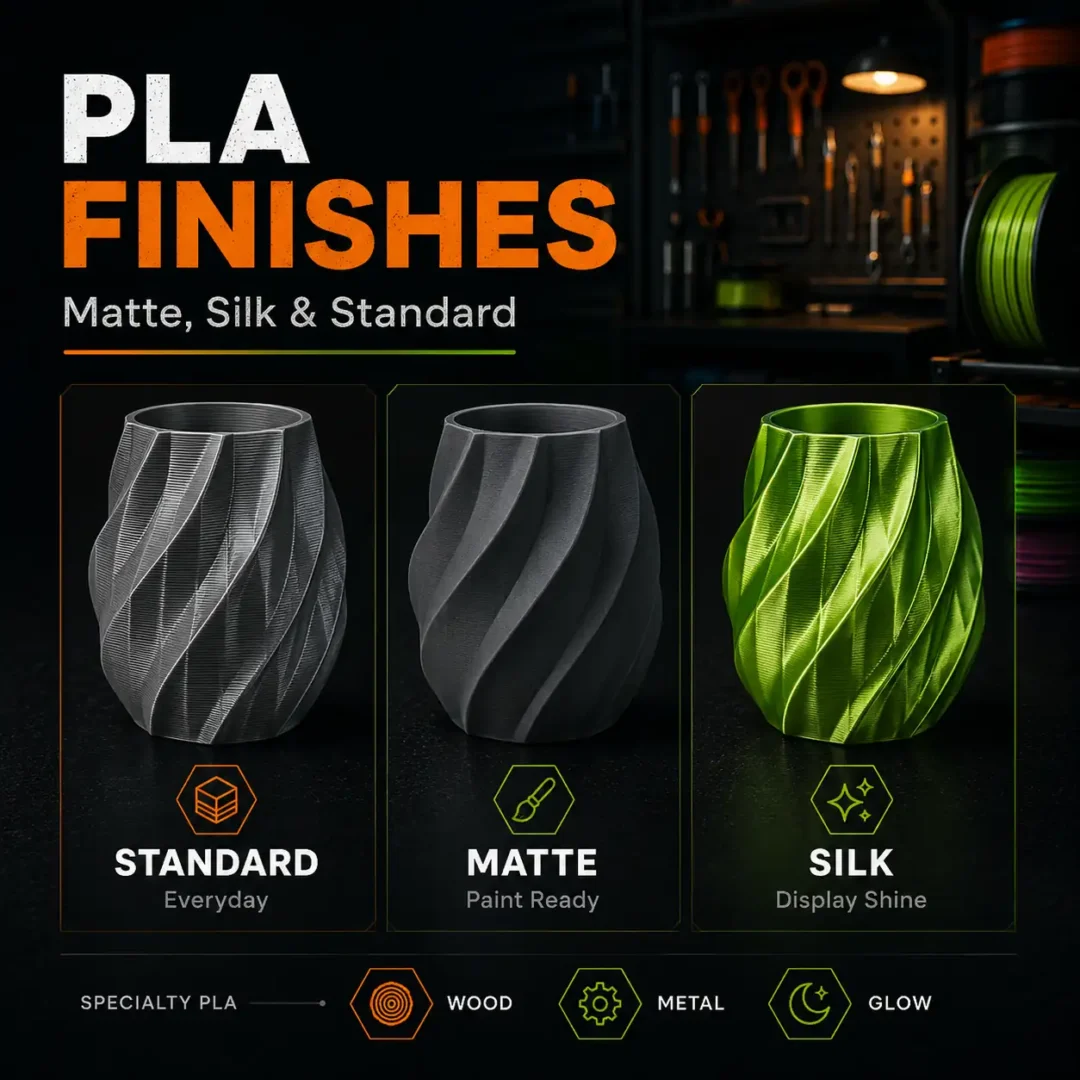
PLA is available in three main surface finish types that produce dramatically different results from the same printer and settings.
Standard PLA has a slight sheen and is the most widely available. Good for functional prints where appearance is secondary. Takes paint reasonably well with primer preparation.
Matte PLA has a flat, non-reflective surface with microscopically rough texture. This texture is what makes it the best choice for any print you plan to paint. Primer and acrylic paint bond naturally to matte PLA without heavy sanding. See our full guide: Why Matte Filament Is Best for Painted Prints.
Silk PLA has a metallic-like sheen that catches light beautifully. Excellent for display pieces left unpainted — the Dollhouse Balcony Railing in silk marble white looks like cast stone straight off the printer. Not recommended for prints that will be painted.
Wood, Metal, and Glow Fills are specialty PLAs with particles mixed in. Wood fill produces a surface that can be sanded and stained. Metal fill is heavy and visually convincing. Glow-in-the-dark contains particles that require a hardened steel nozzle.
Filament Quick Reference
| Filament | Nozzle Temp | Bed Temp | Enclosure | Best For |
|---|---|---|---|---|
| PLA | 190-220°C | 0-60°C | Not required | Decorative, display, hobby |
| PETG | 230-250°C | 70-85°C | Not required | Functional parts, moderate heat |
| ABS | 230-250°C | 100-110°C | Required | High heat, acetone smoothing |
| TPU | 220-240°C | 40-60°C | Not required | Flexible parts, gaskets |
| ASA | 240-260°C | 90-110°C | Recommended | Outdoor UV-resistant parts |
Where OreKo Sources Its Filament
Every OreKo model is tested with eSUN filaments before the file is published. Their PLA Basic and Matte PLA deliver the consistency we need for reliable settings documentation — temperature, flow, and surface finish stay predictable spool to spool. That predictability is what lets us publish specific settings on each model page with confidence.
eSUN is one of the largest filament manufacturers in the world. Their full range — PLA, PLA+, Matte PLA, PETG, ABS+, TPU, silk, wood fill, and specialty filaments — is available through the eSUN Official Store.
Disclosure: the eSUN link above is an affiliate link. If you purchase through it, we earn a small commission at no cost to you. We only recommend products we use ourselves.