
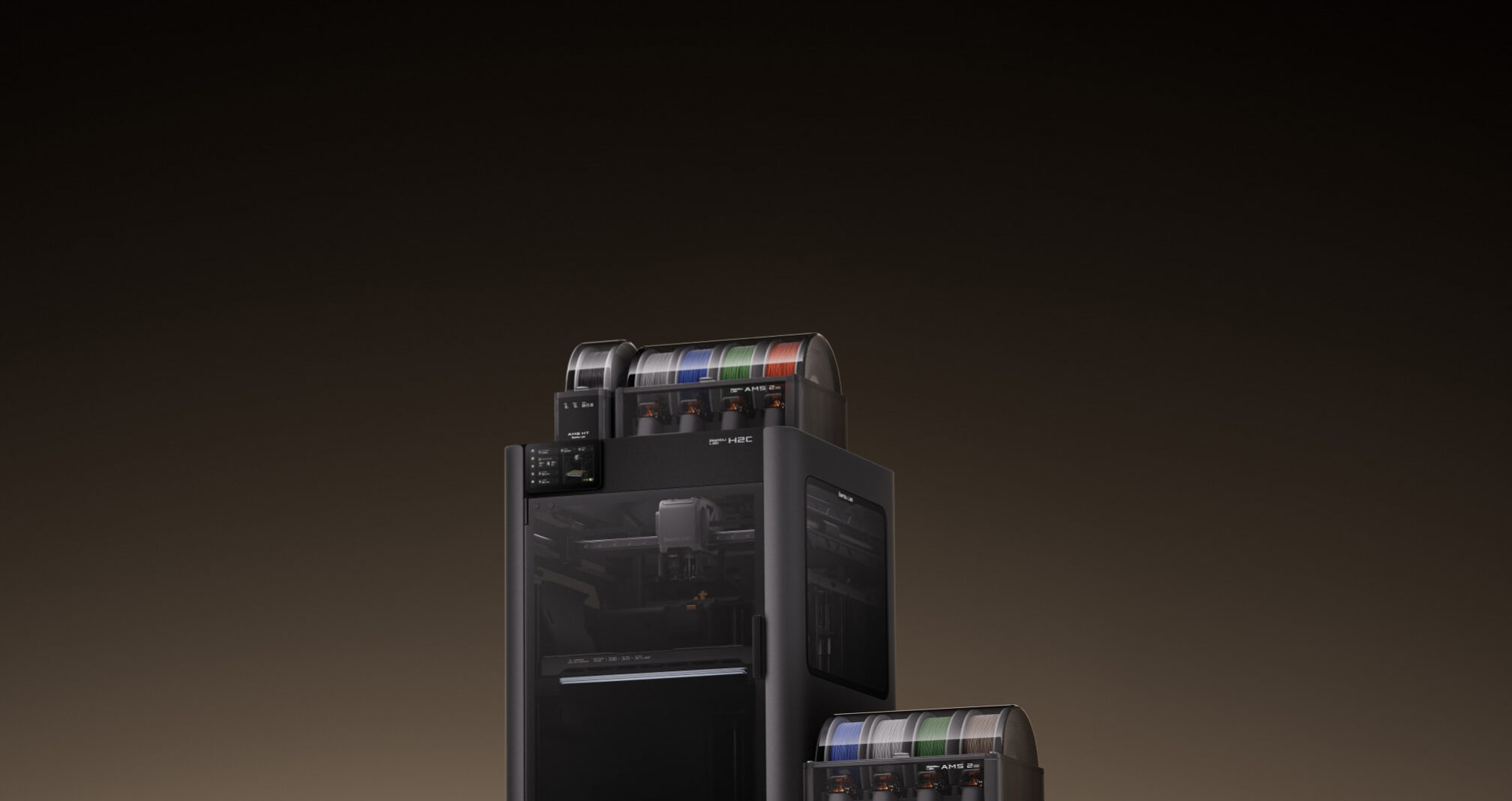
The Vortek System Changes How Multi-Material Printing Works
Announced at Formnext in November 2025 and launched in January 2026, the Bambu Lab H2C is the most technically ambitious printer Bambu has ever built. It is the company’s first toolchanger, and the Vortek system at its core solves a problem that has plagued multi-color FDM printing since the beginning: filament waste.
At $2,399+, the H2C is not a machine for beginners. It is for serious makers, small production shops, and anyone who regularly prints multi-color models and has watched hundreds of dollars of filament disappear into the purge block.
Key Specs
| Spec | H2C |
| Build Volume | 330 x 320 x 325mm |
| Toolhead System | Vortek (up to 6 induction hotends) |
| Hotend Swap Time | ~8 seconds (induction heating) |
| Max Colors Per Print | 7 (6 Vortek + 1 fixed) |
| Purge Waste | Near-zero (no purge needed between hotends) |
| Chamber Heating | Active, up to 65°C |
| Max Nozzle Temp | 350°C |
| HEPA + Carbon Filter | Yes |
| Price | $2,399+ |
How the Vortek System Works
Traditional AMS-based multi-color printing works by pushing a new filament through the same nozzle and purging the old color into a waste block. Every single color swap generates wasted filament. On a complex 4-color figure that makes 400 color changes, that waste accumulates fast and can add up to hundreds of grams of discarded material per print.
Vortek solves this by having a dedicated hotend for each color. The printer physically swaps the active hotend using induction-heated tools that reach temperature in approximately 8 seconds. When the printer switches from color 1 to color 2, it docks hotend 1, picks up hotend 2 (which is already loaded with color 2’s filament), and resumes printing. No purging. No waste block. No waste.
The data transmitted from each hotend is wireless, which means no wiring tangles during the swap. The system supports up to 6 Vortek hotends plus 1 fixed hotend, enabling 7-material prints in a single job.
The Waste Problem in Real Numbers
To understand why Vortek matters, consider a practical example. Printing a detailed 6-color anime figure on a P2S with AMS might involve 600 color changes. At an average purge volume of 2-3g per change, that is 1,200-1,800g of wasted filament. At $25 per kg, a single complex figure could generate $30-45 in filament waste on a conventional AMS printer.
On the H2C with Vortek, the same print generates near-zero purge waste. The cost saving per print compounds quickly for anyone doing regular multi-color printing. For small businesses producing figures, cosplay pieces, or detailed props, the H2C’s premium price is recoverable in filament savings within a year of regular use.
Who Should Buy the H2C
- Small production shops printing complex multi-color models at volume
- Etsy sellers and print businesses where filament waste directly impacts margins
- Makers producing detailed anime figures, gaming miniatures, or character models regularly
- Anyone who has calculated their purge waste and found it unacceptable
- Studios that want up to 7-material prints in a single job
Who should not buy the H2C: Casual hobbyists printing occasionally. Anyone buying their first or second printer. Users whose projects rarely exceed 2-3 colors. The P2S or X2D with AMS handles the majority of multi-color hobbyist work without the H2C’s complexity and cost.
H2C vs H2D: Which to Buy
These two machines solve different problems. The H2D is for makers who need true dual-material printing simultaneously — model plus soluble support, two engineering-grade materials at once, or laser engraving alongside 3D printing. The H2C is for makers who need maximum color count with minimum filament waste.
If your primary interest is clean multi-color figure and prop printing, the H2C wins. If your interest is material diversity, laser capability, and dual-material workflows, the H2D is the better fit. Both are prosumer machines. Pick based on what you actually build.
Zero Waste. Seven Colors. One Machine.
The H2C is the top of the Bambu food chain for multi-color printing. Start with OreKo files on Cults3D.