
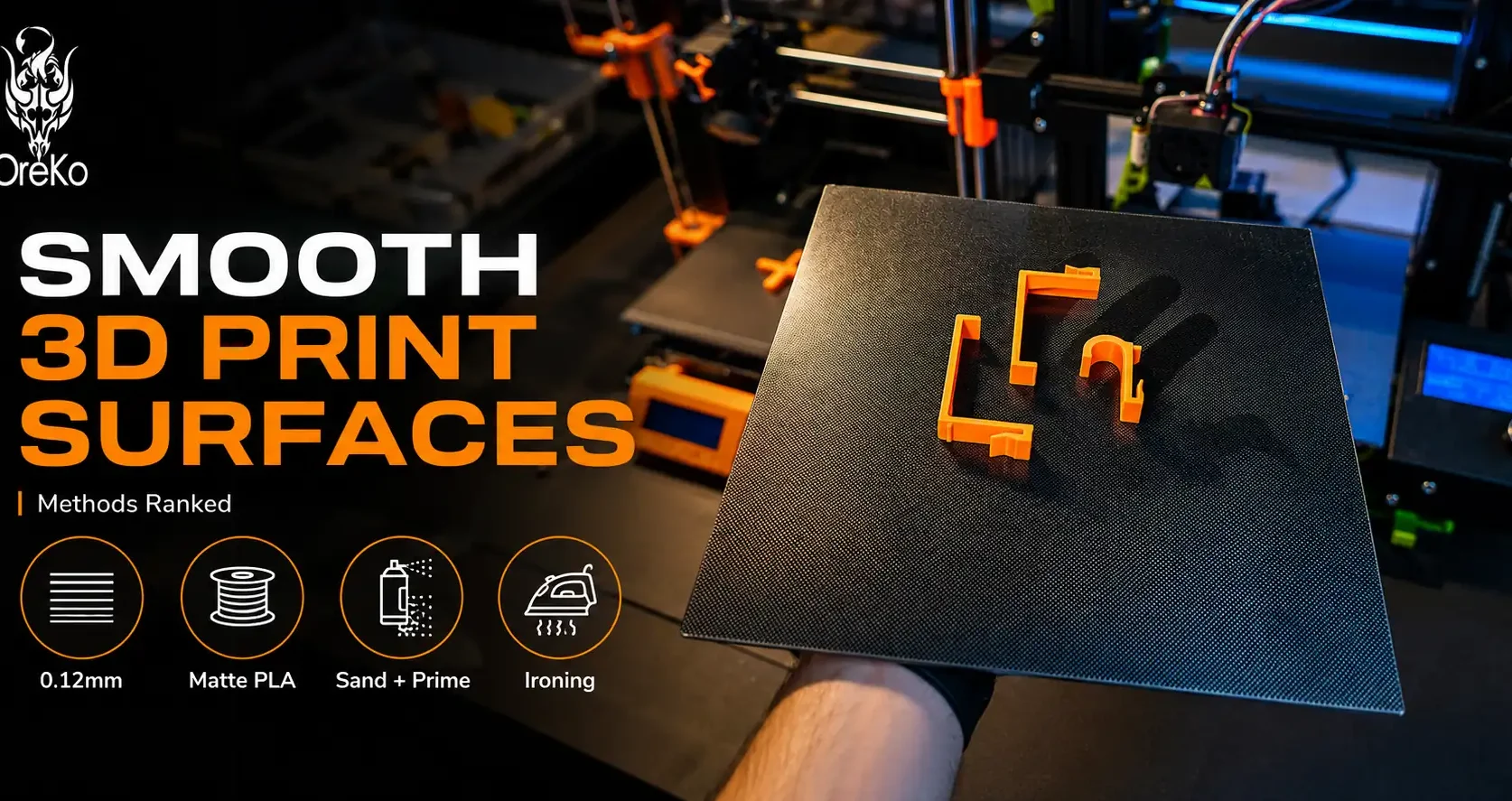
FDM prints have visible layer lines. That’s the nature of the technology. Getting rid of them, or reducing them enough that they’re not visible at normal viewing distance, is achievable through a combination of slicer settings and post-processing techniques. Here’s every method ranked by effort and result.
Method 1: Fine Layer Height (Easiest, No Post-Processing)
Dropping from 0.2mm to 0.12mm layer height reduces the height of each layer ridge by 40%. On curved surfaces, the improvement is immediately visible. It’s not invisible, but it’s much closer to smooth. Cost: roughly 60-70% more print time. For display pieces and detailed accessories where appearance matters, this trade is usually worthwhile.
Method 2: Matte Filament (No Extra Work)
Matte PLA’s surface texture scatters light rather than reflecting it off layer lines. The same physical ridges that look obvious on shiny standard PLA are far less visible on matte PLA because there’s no specular reflection to highlight them. No extra work, just a material choice. All OreKo models are photographed in matte PLA for this reason.
Method 3: Primer and Sanding (For Painted Pieces)
If the piece gets painted, filler primer fills micro-texture and light sanding between coats produces a surface that’s indistinguishable from injection-molded plastic under paint. Two rounds of filler primer and 220-400 grit sanding removes layer lines from any PLA surface. Time cost: 30-60 minutes per piece in drying and sanding time. Full process at the painting guide.
Method 4: Ironing (For Flat Top Surfaces)
Ironing is a slicer feature that adds a finishing pass over the top surface at near-zero extrusion, using the nozzle heat to smooth and flatten the top layer. Produces a glassy smooth top surface. No effect on side walls. Adds 10-20% to print time. Available in Bambu Studio under Quality settings.
Frequently Asked Questions: Smooth 3D Prints
Can you make a 3D print completely smooth without sanding?
Close to it, but not perfectly. Matte PLA at 0.12mm layer height with ironing on flat surfaces gets very close to smooth without any post-processing. Curved surfaces still have a slightly ribbed texture at close inspection. Full smoothness requires primer and sanding for most FDM prints.
What is the best way to smooth PLA 3D prints?
Filler primer (spray can, multiple thin coats) followed by 220-400 grit wet sanding is the most effective method that preserves dimensional accuracy. ABS can be acetone-vapour smoothed, which produces a glossy result without sanding, but PLA doesn’t respond to acetone the same way.
Does ironing work on all surfaces?
Ironing only affects flat top surfaces. It has no effect on vertical walls or curved side faces. For a deck box lid with a flat top, ironing produces an excellent smooth result. For the curved sides of a figurine, it does nothing. Combine ironing for flat areas with fine layer height for curved areas for the best overall result.