STL File Licenses Explained: What You Can and Cannot Print

Downloading a free STL file does not give you unlimited rights over it. Here is what the common license types actually allow, where the lines are drawn, and what to check before you sell anything you print.

Why Licenses Matter for 3D Printing

3D printing makes it easy to take someone else’s digital design and produce a physical object from it. That ease creates a legal question that most hobbyist printers never think about until they encounter it: who owns the rights to the design, and what are you allowed to do with it?

For personal printing — making something for yourself, your home, or as a gift to a friend — the answer is almost always straightforward. Nearly every free STL license permits personal use. Where it gets more complicated is commercial use: selling printed copies, using a design in products you sell, or printing for customers who pay you.

This guide covers the license types you will actually encounter on every major platform, in plain language.

Creative Commons Licenses: The Standard

Most free STL files use Creative Commons licensing. These licenses are standardised, well-understood, and built from four modular conditions that combine to create different permission levels.

BY (Attribution)

You must credit the original creator when you use, share, or adapt the work. Almost every CC license includes this condition. In practical 3D printing terms, it means crediting the designer if you post photos of your prints on social media, or listing the source if you share the file further.

SA (Share-Alike)

If you adapt or remix the work, you must release your adaptation under the same or equivalent license. You cannot take a CC BY-SA model, modify it, and release the modification under a more restrictive license. The open nature of the original must carry through.

NC (Non-Commercial)

You may not use the work for commercial purposes. Selling printed copies of an NC-licensed design is not permitted. Printing it to display in a shop window, using it in a product you sell, or printing it for paying customers all fall under commercial use. Personal printing is always fine.

ND (No Derivatives)

You may not modify, adapt, or build upon the work. You can print and share it as-is, but you cannot change the design, resize it for a different purpose, or incorporate it into a larger design. The original must remain intact.

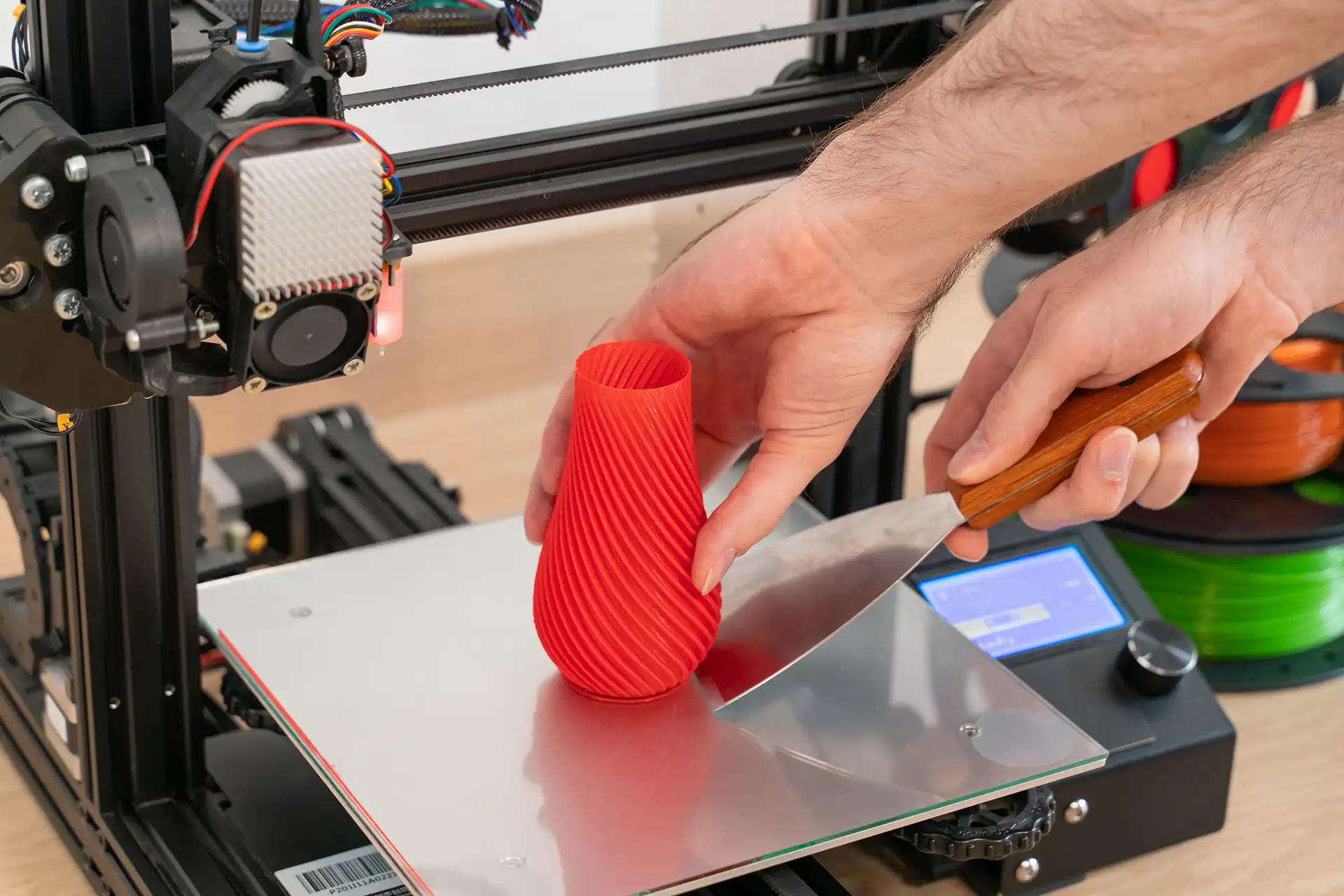
Person finishing and post-processing a 3D printed object with a tool at a workshop table

The Common License Combinations

The four CC conditions combine into six standard licenses. These are the ones you will actually encounter on Printables, Thingiverse, and Cults3D.

CC BY — Attribution only. The most permissive standard license. You can print, sell, modify, and redistribute as long as you credit the creator. Least common for 3D printing designs because it allows commercial use without restriction.

CC BY-SA — Attribution and Share-Alike. Print, sell, and modify freely, credit the creator, and any derivatives must carry the same license. Used by designers who want their work to remain open but also want commercial use allowed.

CC BY-NC — Attribution and Non-Commercial. The most common license for free hobby designs. Personal printing is explicitly permitted. Selling prints is not. Modification is allowed for personal use. This is what most Thingiverse and Printables designers use.

CC BY-NC-SA — Attribution, Non-Commercial, and Share-Alike. Same as BY-NC but derivatives must also be released as non-commercial. A popular choice for designers who want their work remixed freely within the hobbyist community but not commercialised.

CC BY-ND — Attribution and No Derivatives. Print and share as-is, credit required, no modifications. Less common in 3D printing because remixing is part of the culture.

CC BY-NC-ND — Attribution, Non-Commercial, No Derivatives. The most restrictive CC license. Personal printing only, exactly as designed, with credit. No selling, no modifying.
License Quick Reference

License Personal Print Sell Prints Modify Redistribute Credit Required
CC BY Yes
CC BY-SA ✓ (same license) ✓ (same license) Yes
CC BY-NC ✓ (personal) ✓ (non-commercial) Yes
CC BY-NC-SA ✓ (same license, non-commercial) ✓ (same license, non-commercial) Yes
CC BY-ND ✓ (unmodified) Yes
CC BY-NC-ND Yes
CC0 (Public Domain) No

Platform-Specific and Custom Licenses

Not every STL file uses Creative Commons. Several platforms have their own licensing frameworks, and many designers write custom license terms in their listing descriptions.

Printables License

Printables uses CC licensing but also allows designers to select a “Personal Use Only” option that sits outside the standard CC framework. Personal Use Only means exactly what it says: print it for yourself, do not sell prints, do not redistribute, do not modify for public release.

Cults3D Licenses

Cults3D displays the license clearly on every listing. Free files typically use CC variants. Paid files often come with a commercial license that permits selling printed objects up to a certain quantity or revenue threshold. Read the specific license on each paid listing — terms vary by designer.

MakerWorld

MakerWorld uses CC licensing and also has a Bambu Lab-specific commercial tier for designers who opt into it. Prints from commercial-tier models can be sold with explicit permission documented in the listing.

Thingiverse

Thingiverse uses CC licensing. Licenses are shown on each listing. Many older uploads have no license set, which defaults to the designer’s original rights — meaning personal use only is the safest assumption for any unlicensed listing.

Custom Designer Licenses

Some designers write their own terms rather than using a standard license. These are legally valid but less standardised. Read them carefully. If a designer’s custom terms say “personal use only, no commercial printing, credit required” then those terms apply regardless of what you paid for the file.

The Commercial Printing Question

The most common licensing question for 3D printing: can I sell prints of this file?

When you can sell prints

  • The file is licensed CC BY or CC BY-SA (commercial use allowed)
  • The file is CC0 (public domain, no restrictions)
  • The designer explicitly states prints may be sold in the listing description
  • You purchased a commercial license specifically for selling prints
  • The designer has given you direct written permission

When you cannot sell prints

  • The file is licensed CC BY-NC or CC BY-NC-SA or CC BY-NC-ND
  • The listing says “Personal Use Only” in any variation
  • The designer’s custom terms prohibit commercial printing
  • No license is specified (default to personal use only)
  • You are unsure — if in doubt, ask the designer directly before selling

A Note on Intellectual Property Beyond CC Licensing

Creative Commons licensing only applies to original designs created by the file’s author. It does not and cannot grant rights to third-party intellectual property embedded in a design.

A 3D model of a character from a film, game, or comic — even if the STL file is released under CC BY — still contains intellectual property that belongs to the IP owner. The CC license covers the designer’s original work in creating that specific mesh. It does not transfer the film studio’s or game publisher’s rights to you.

This means: printing a fan-made design of a trademarked character for personal enjoyment is generally tolerated by most IP holders and falls under fair use in many jurisdictions. Selling prints of that same character without a license from the IP owner is a different situation entirely, regardless of what the STL file’s CC license says.

If you plan to sell prints commercially, stick to designs that are either original work or explicitly released for commercial use by designers who own all the IP in their designs.

Frequently Asked Questions

Can I print any free STL file for personal use?

Yes, in virtually every case. All standard Creative Commons licenses and most platform-specific licenses explicitly permit personal, non-commercial printing. The only exception would be a designer who explicitly states that no printing is permitted at all, which is extremely rare and would make the file useless as a 3D printable. For personal printing at home for your own use, you are almost always covered.

Can I give printed objects as gifts?

Yes. Giving a printed object as a personal gift is considered personal non-commercial use under all standard CC licenses. Selling prints is commercial use. Gifting is not. The distinction is whether money changes hands.

What happens if I sell prints of a non-commercial file?

Technically you would be infringing the license terms, which constitutes copyright infringement. In practice, enforcement at small scale is rare. Most designers who discover their NC-licensed work being sold commercially start with a cease-and-desist message rather than legal action. The practical and ethical position is to check the license before selling and to ask the designer for a commercial license if one is not offered. Many designers are willing to negotiate commercial terms directly.

Do I need to credit the designer when posting photos of my prints?

If the file uses any CC license that includes the BY (Attribution) condition — which is almost all of them — then yes, crediting the designer is required when you share or publish work based on their design. In practice, this means tagging or naming the designer when posting print photos on social media or in community forums. It is also just good community practice that keeps designers motivated to share their work for free.

Can I modify a free STL file and share my modified version?

It depends on the license. CC BY and CC BY-SA allow modifications. CC BY-NC and CC BY-NC-SA allow non-commercial modifications. CC BY-ND and CC BY-NC-ND prohibit modifications entirely. If the license allows modifications, check whether it also requires Share-Alike — if it does, your modified version must carry the same license. Always credit the original designer on any derivative work.

Continue Learning

How to Choose a Good STL File

Quality signals that separate tested files from render-only uploads, across every major platform.

Where to Find Free STL Files

The honest breakdown of free repositories and what makes each one worth using for different needs.

How to Create Your Own STL Files

If you want to design original models rather than download them, here is where to start.