
June 1, 2026 — Official Reveal
The A2L is official. Here is what Bambu confirmed.
Build volume: 330 × 320 × 325 mm. That is 105% more print space than the A1. We predicted the H2S plate footprint and landed within millimeters. A full-scale helmet in one piece. A batch of 40 fidget toys in one run. The projects that used to require splitting a model now just fit.
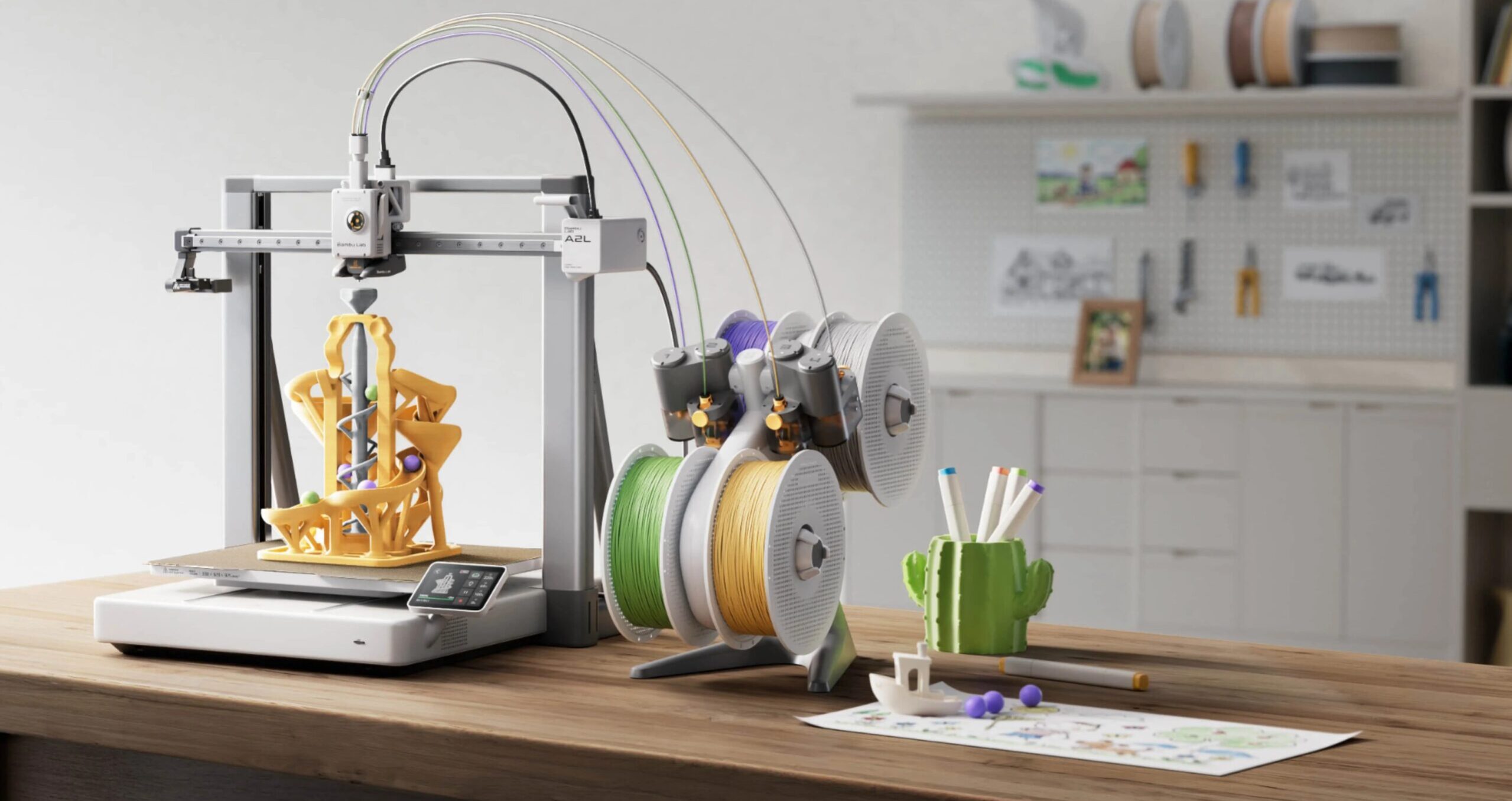
The PMSM servo extruder is confirmed — called it from the H2S trickle-down pattern. Add Adaptive Vibration Compensation that recalibrates in real time layer by layer, Granular Dampers borrowed from aerospace engineering, Auto Flow Dynamics Calibration before every print, AMS Lite compatibility with 2nd-Gen AMS support up to 19 colors, 49dB Silent Mode, and UL GREENGUARD indoor air quality certification.
The thing nobody predicted: a blade cutting module. Swap the toolhead cover and the A2L cuts — vinyl, leather, fabric, stickers, paper. It draws with a pen. This is a 3D printer that is also a Cricut-style cutter. That is what “Creative Playground” actually meant. Not a single leak roundup had this.
What we missed: The 4-head simultaneous color theory was wrong — Bambu scaled multi-color through AMS mixing to 19 colors instead. The cutting module was off everyone’s radar, including ours. The full original analysis and speculation is below.
The Bambu A2L is official. $569 USD. Free shipping. Here is the full picture.
What we got right before the reveal: the H2S plate footprint, the PMSM servo extruder from the H2S tech stack, AMS Lite compatibility, bedslinger design.
Speaking of that ecosystem: the feature nobody predicted is a blade cutting module. Swap the toolhead cover and the A2L cuts vinyl, leather, fabric, stickers, paper. It also draws with a pen. Bambu quietly built a Cricut competitor into a 3D printer.
May 30, 2026 — Initial Post
Bambu Lab officially teased their next printer yesterday. It is called the A2L. The full reveal is June 1, 2026 at 4 PM CEST. Right now there is a lot of forum speculation and almost no confirmed information, which means this is exactly the moment to separate what we actually know from what we are reading into the marketing.
We are going to do both. Clearly labeled. Everything confirmed first, then what we think is coming, then the big speculation that we think could redefine multi-color printing entirely. And we will update this post the moment specs drop on June 1.
What We Know for Certain
Bambu confirmed these details directly through their official community forum post and marketing materials.
- Official name: Bambu Lab A2L
- Official reveal: June 1, 2026 at 4 PM CEST
- Official tagline: “Creative Playground. Extra Large.”
- Multi-color printing confirmed: marketing materials already show multi-color output
- A-series family: open-frame bedslinger, the same family as the A1 and A1 Mini
- Second generation: the “2” means gen 2, the “L” means large format
That is it. Everything else below is analysis, pattern recognition, and speculation. We will tell you which is which.
What We Think It Will Include
Build Volume: The H2S Plate Theory
The Bambu Lab H2S currently holds the largest build volume in the Bambu lineup at 340 x 320 x 340mm. Bambu already manufactures these plates at scale. Sharing build plate components between an H-series machine and a new A-series flagship is exactly how Bambu keeps pricing competitive while expanding the lineup.
The A1 runs 256 x 256 x 256mm. “Extra Large” as a tagline implies a step up from that, not a minor increase. A build volume in the 320-340mm range puts the A2L in a completely different category for large-format hobby work: full cosplay armor sections, complete dollhouse room assemblies, large game boards, prop pieces that previously required splitting.
Our call: the A2L build plate will be in the 320-340mm range, possibly sharing the same plate footprint as the H2S to reduce manufacturing complexity.
PMSM Servo Extruder
Community forum leaks specifically mentioned a PMSM closed-loop servo extruder for the A2L. The H2S already uses the same technology. Bambu describes it as delivering 67% more extrusion force than a regular stepper motor with active filament grinding detection built in.
Bringing PMSM servo down to an A-series price point would be a significant spec for hobby users. Better extrusion stability means fewer clogs, more reliable high-speed printing, and better performance with flexible filaments. This is consistent with how Bambu has handled every generation: H-series gets the new hardware, then it trickles down.
Dual Nozzle: Possible, But Not Our Top Bet
A 2025 patent showed a dual-nozzle setup on an A-series style body. The X2D launched in April 2026 with dual nozzle architecture. Bambu is clearly building toward dual extrusion across the lineup.
That said, putting a full dual nozzle system on an A-series printer at an A-series price would step directly on the X2D’s value case. Bambu does not typically cannibalize their own lineup that fast. We think dual nozzle is possible but less likely than the build volume and PMSM upgrades for the A2L specifically.
What We Wish It Would Include
The 4-Head Theory: Solving Multi-Color Printing Differently
This one is pure speculation. We have no leaks, no patents, no insider information. What we have is an engineering problem that has not been solved yet and a new machine positioned as “Creative Playground” with multi-color printing front and center.
Here is the problem. The current AMS Lite works like this: four PTFE tubes run from four spools into a 4-in-1 splitter, which feeds into a single direct drive extruder and out through one nozzle. Every time a color changes, the printer has to retract the current filament, push the new one forward, purge the old color out of the nozzle, and dump that purged material into a purge tower sitting on your build plate. On complex multi-color jobs, that purge tower can consume 15-25% of your total print volume and time. It is the number one complaint from multi-color users across every platform.
What if the A2L solved it with a different architecture entirely? Instead of four tubes converging into one head, imagine four individual print heads — one per color — all mounted on the same X-axis gantry. Each PTFE tube feeds its own dedicated head. Each head is always loaded with its assigned color. A selective Z-drop mechanism activates whichever head is printing the current color zone while the others lift slightly out of the way.
The result: zero purge tower. No color contamination. No retraction and reload cycles between color changes. True multi-color printing where each color prints exactly when it needs to from a dedicated nozzle that has never touched another filament.
On a bedslinger this is mechanically simpler than you might think. The bed moves in Y. The X-gantry carries all four heads as one unit. There is no tool-changing mechanism, no parking, no pickup. Four small direct-drive heads move together. The slicer assigns each color zone to the correct head and the print runs.
The tagline “Creative Playground” is doing a lot of work here. That is not how Bambu describes a printer that prints slightly bigger. That is how you describe a printer that changes how people think about multi-color printing. We could be completely wrong. This might be a bigger A1 with a new spool holder. But if June 1 shows four heads on the A2L gantry, you read the theory here first.
What It Means for A1 and A1 Mini Owners
If you currently own an A1 or A1 Mini, the A2L is not automatically an upgrade. The A1 Mini at 180mm and A1 at 256mm cover the majority of hobby printing needs. Deck boxes, miniatures, cosplay props, functional tools — most of what we print here fits comfortably on either machine.
The A2L will matter most if you regularly hit the 256mm ceiling. Full cosplay chest pieces, large room-box sections, game boards, multi-part prints you currently have to split and glue. If that describes your work, the A2L is worth serious attention.
If you are currently deciding whether to buy an A1 Mini and the A2L is on your radar: wait four days. See the price. If the A2L comes in under $500 with AMS Lite included, that changes the calculus significantly. If it comes in at $700 or more, the A1 Mini Combo at $449 remains the better value for most hobby use cases.
The AMS Question
The A2L is an A-series printer, which means AMS Lite compatibility is the expected default. What nobody knows is whether Bambu ships an updated AMS Lite 2 alongside it, whether the A2L supports more units than the current A1 ceiling of two, or whether a completely new multi-color architecture makes the question irrelevant.
For a full breakdown of how the current AMS and AMS Lite compare and which printers use which system, read the AMS vs AMS Lite comparison. For a full review of the current A1 Mini, the Bambu Lab A1 Mini review covers everything from print quality to price to who should buy it.