
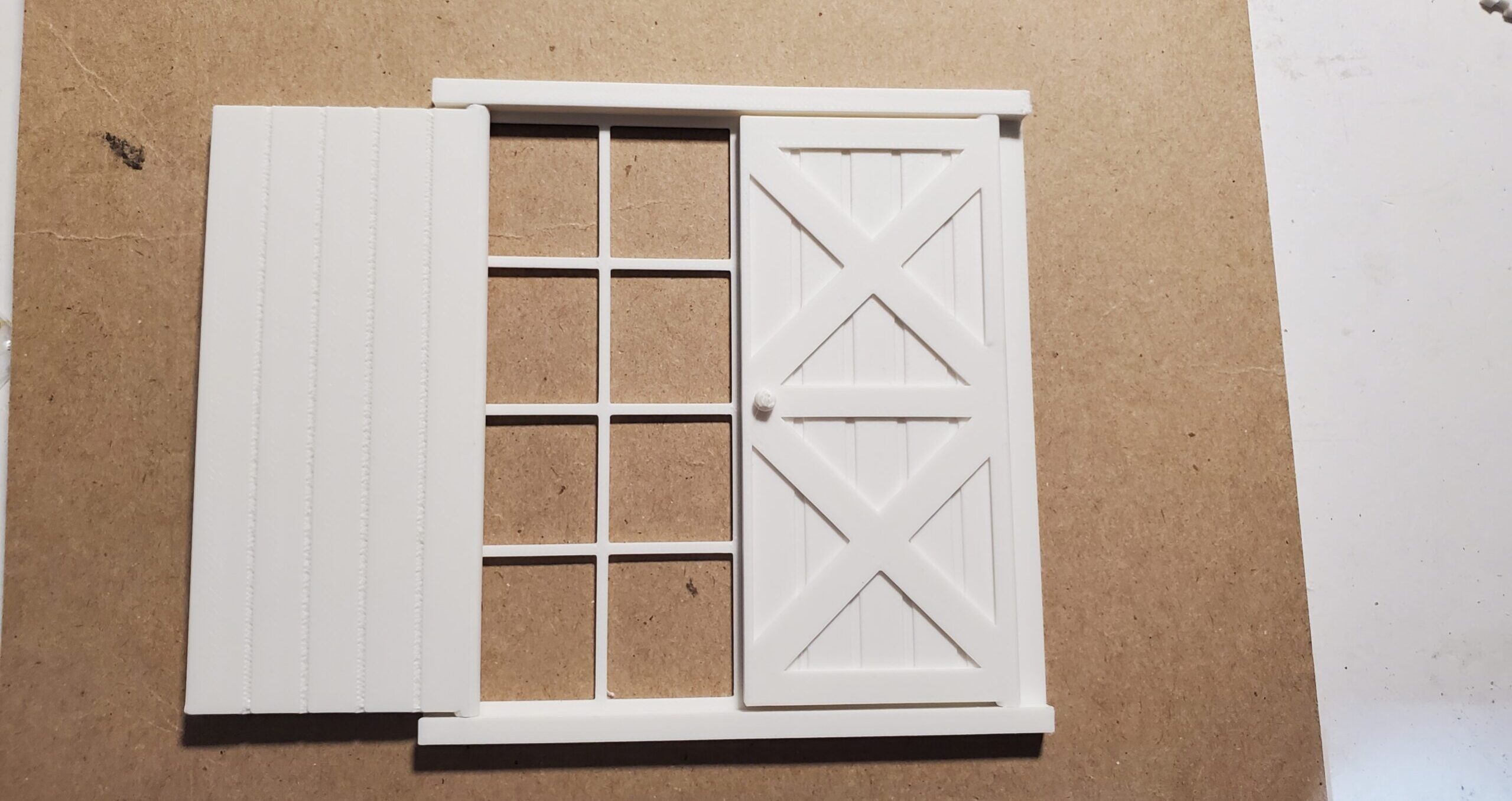
Printing Miniature Windows: What Makes Them Tricky
Miniature windows are one of the most satisfying 3D prints in the dollhouse catalog. They are also one of the most technically demanding. Thin frames, small moving shutters, fine decorative detail, and precise hinge tolerances all need to come together for the finished piece to look and function properly.
The OreKo miniature window collection includes three shutter style variations plus a window with an integrated planter. All are designed for support-free FDM printing. Here is how to get them right.
Print Settings for the Window Set
Layer height: 0.12mm
This is the most important setting for miniature windows. At 0.12mm the frame profiles are clean, the shutter slats are distinct, and the hinge pin holes are accurately sized. At 0.20mm the thin frame elements look rough and the hinge tolerances become unreliable.
Infill: 100%
The window pieces are small. 100% infill ensures every thin wall and small structural element is fully solid. The extra infill adds almost no print time at this scale.
Wall lines: 3
Three perimeters add meaningful strength to the thin frame profiles without affecting the overall dimensions significantly.
Supports: None
All pieces are designed to print without supports in the orientations provided. Do not add supports automatically.
Print speed: Slow down
Reduce print speed for the shutter pieces specifically. Most slicers have a minimum layer time setting (10-15 seconds) that automatically slows the print on very small parts. Enable this.

The Filament Pin Hinge: Step by Step
The working shutters use 1.75mm filament as a hinge pin. This is an elegant solution that requires no hardware and produces a smooth pivot. Here is exactly how to assemble it:
Step 1: Print the frame and shutters separately at 0.12mm. Do not glue anything until the shutters are assembled.
Step 2: Test fit without the pin. Slide the shutter into the frame hinge slot and check that it moves freely. If it binds, lightly sand the hinge area with fine sandpaper.
Step 3: Cut the hinge pin. Use a sharp hobby knife or flush cutters to cut a piece of 1.75mm filament to the exact length of the hinge barrel. The length varies by the shutter design but is specified in the product listing.
Step 4: Thread the pin. Hold the shutter in the frame at the hinge point and push the filament pin through the aligned holes. It should go in with light pressure.
Step 5: Test movement. The shutter should pivot cleanly. If it is stiff, push the pin through slightly further so it seats past any rough entry point.
Troubleshooting Common Window Print Issues
Frame edges look rough or fuzzy. Increase retraction slightly in your slicer to reduce stringing at travel moves. Also check your nozzle temperature is not too high.
Shutter pin holes are too tight or too loose. This is a calibration issue. Run a first-layer calibration on your printer. If the holes are consistently off, you can also adjust your printer’s horizontal expansion (elephant foot compensation) setting.
Thin frame sections broke during removal from bed. Use a flexible build plate and flex it gently to release parts rather than prying. Let the plate cool fully before attempting removal on thin parts.
Shutter slat lines are blurry. Drop to 0.08mm layer height on the shutter pieces specifically. The slat detail is fine enough to benefit from the lowest practical layer height.
Planter detail on the planter window is soft. The planter window benefits from 0.12mm or lower. The decorative rail and post detail on the planter reads much more cleanly at fine layer heights.
Painting and Finishing Miniature Windows
The window set prints beautifully in white or cream PLA — we use eSUN PLA for the full window set, including the shutter accent colors. The color range covers bright white frames through to deep green, terracotta, and dark blue shutters without needing to switch brands.
Here is a quick finishing approach that works well:
1. Prime lightly. A thin coat of grey or white filler primer seals the layer lines and gives paint something to grip. Use spray primer and apply in thin coats to avoid obscuring fine detail.
2. Base coat. White, cream, or any traditional window frame color. Satin finish looks more realistic than flat on architectural pieces.
3. Shutter accent color. Classic shutter colors like dark green, dark blue, or terracotta contrast well with white frames. Brush-apply to the shutters before assembly.
4. Assembly and glazing. Assemble shutters with the filament pins after painting. A thin sheet of clear acetate or transparency film cut to fit the window opening creates a convincing glass pane effect.
This post contains an affiliate link. If you purchase through it, we earn a small commission at no extra cost to you.