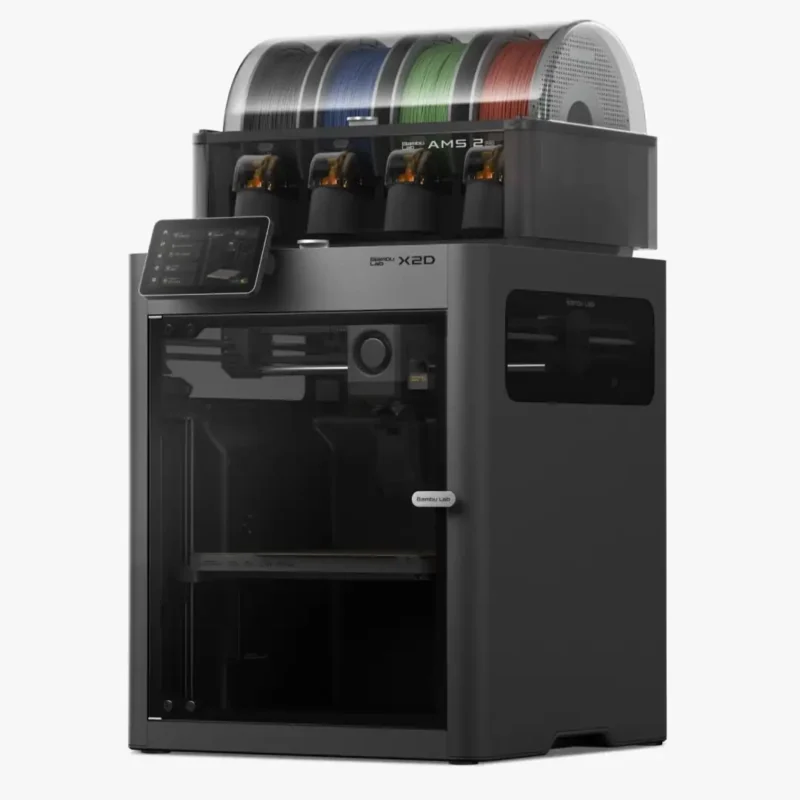
Bambu Lab X Series: Compact Enclosed Dual Extrusion

The X Series is Bambu Lab’s compact enclosed workhorse tier — the flagship desktop lineup for makers who want professional results without the H Series footprint or budget. The current model, the X2D, brings dual extrusion, active chamber heating, and LiDAR as standard equipment at $649+.

The X Series Today

The X Series has been Bambu Lab’s compact flagship since the brand launched. The original X1 Carbon established the formula: enclosed CoreXY, high speed, reliable results with minimal setup. The X2D, launched April 14, 2026, takes that foundation and adds what the X1C’s users asked for — dual extrusion, active chamber heating, and the full H2-generation sensor and camera suite.

Formerly also included: X1 Carbon (X1C) and X1E. Both are end-of-life as of 2026 and no longer sold new. The X1C was one of the most popular desktop 3D printers of its generation. Existing X1C machines continue to work and receive firmware support, but new buyers should purchase the X2D instead.

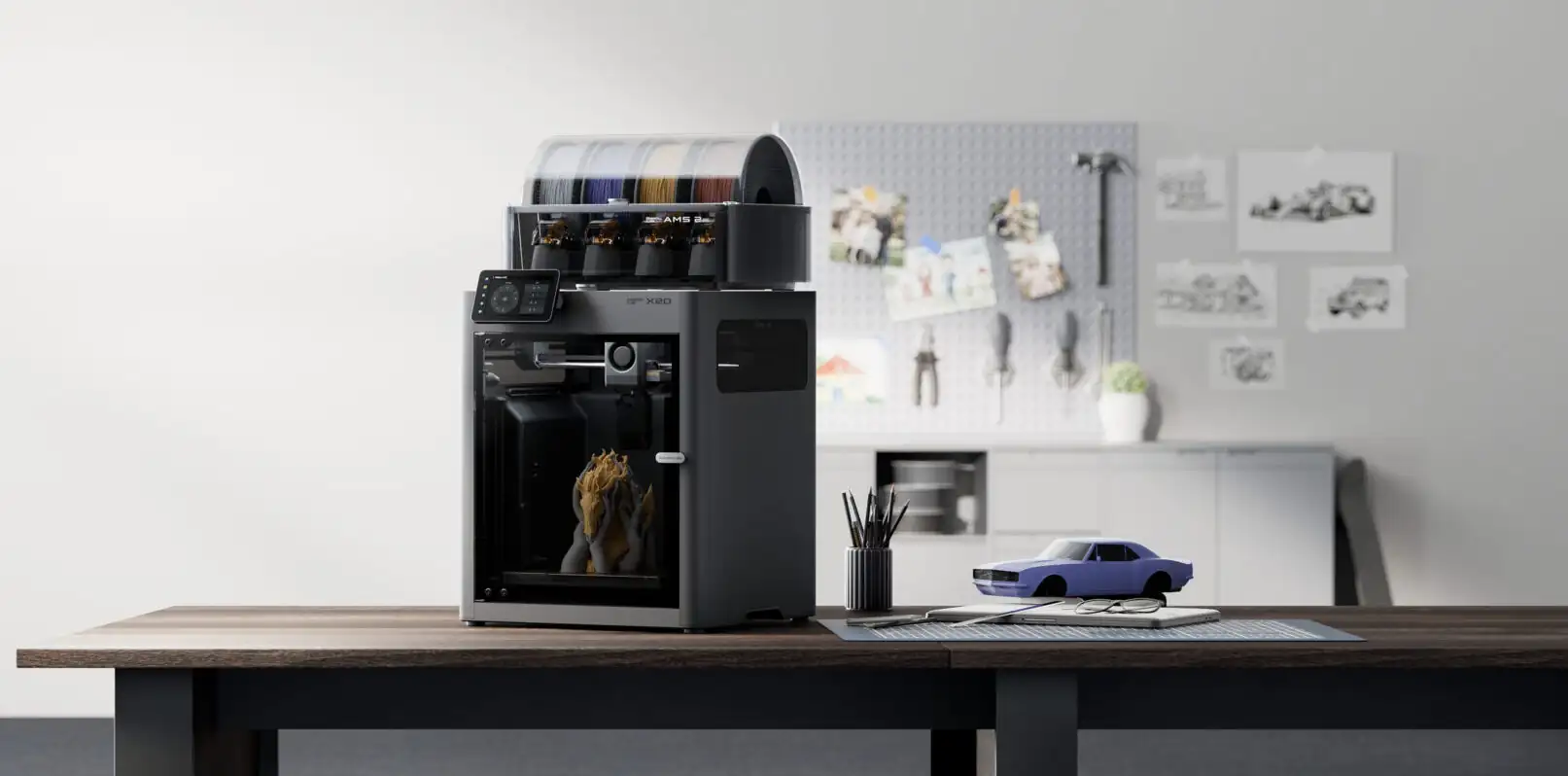
Bambu Lab X2D — From $649+

Dual nozzles. Active chamber. Compact body. The X1C successor.

The X2D is the machine the X1C community was waiting for. Same compact enclosed footprint, same role in the Bambu lineup — but with two nozzles instead of one, an actively heated chamber that reaches 65°C, LiDAR standard, and the H2-generation sensor suite that debuted in the H2D. At $649, it slots directly between the P2S ($549) and the H-series, and for most desktop makers it is the better choice over both.

The dual-nozzle system works differently from the H2D. The X2D uses one direct-drive primary nozzle for main print material (capable of TPU and all flexible filaments), and one Bowden-fed auxiliary nozzle for support material or a second color. A mechanical nozzle lifter raises the inactive nozzle out of the print path with a wiper to clean it on each transition. This is not true IDEX — both nozzles share a single carriage — but for the vast majority of two-material workflows it delivers the same practical result: soluble supports, dual-color prints, and multi-material functional parts without purge waste between the two nozzles.

Full Specifications

Build Volume 256 × 256 × 260mm (single nozzle); ~235 × 235 × 250mm (dual nozzle)
Architecture Enclosed CoreXY
Extruder Dual — direct drive primary + Bowden auxiliary with mechanical nozzle lifter
Primary Nozzle Speed Up to 1,000mm/s movement; up to 800mm/s print speed
Auxiliary Nozzle Speed Max 200mm/s print speed
Acceleration 20,000mm/s²
Chamber Heating 65°C active — Cool Mode and Heat Mode switching
Enclosure Yes — three-stage air filtration
LiDAR Yes — standard
Motion Accuracy 50μm with optional Vision Encoder (sold separately)
Sensors 31 sensors — clog, filament tangle, vibration, fire, flow dynamics
Cameras Live view camera + toolhead camera
AI Detection Spaghetti, foreign objects, nozzle clumping, part displacement, purge chute pile-up, build plate recognition
Flow Calibration Flow Dynamics Calibration — nonlinear time-varying model per extrusion system
Hole / Contour Auto Hole and Contour Compensation — holes and edges print to spec automatically
Multi-color AMS 2 Pro compatible — up to 25 colors with multiple AMS units
TPU Support Dedicated TPU feeder on primary nozzle
Nozzle Compatibility Tool-less magnetic nozzle swap — 0.2mm to 0.8mm, standard and hardened steel
Connectivity Wi-Fi, LAN — Bambu Studio + Bambu Handy app
Availability Bambu Lab store, Best Buy (US), Micro Center (US); EU €629 / €849; UK £569 / £769

Variants and Pricing

  • X2D — $649+
  • X2D Combo with AMS 2 Pro — $899+

Best For

Makers who want dual-material printing — soluble supports, two-color designs, and multi-material functional parts — in a compact desktop machine. Anyone upgrading from a P1S, P2S, A1, or X1C who wants dual extrusion without stepping up to H Series pricing or size. The sweet spot for most desktop studios.

Not Ideal For

Makers who only ever print in one material and don’t need dual extrusion — the P2S is $100 cheaper and covers that use case well. Anyone who needs a build volume larger than 256mm — look at the H2S or A2L. Production multi-color work with more than two materials — the H2C’s Vortek system is the right tool.

x2d-11-q60

X2D vs P2S vs H2D — How to Choose

Your situation Recommended Why
Budget under $600. One material at a time. Want enclosed reliable ABS/ASA printing. P2S $549+. Same 256mm build, enclosed, AMS 2 Pro compatible. No dual nozzle or active chamber, but covers single-material enclosed printing well.
Want the best all-round compact Bambu. Dual material, active chamber, full sensor suite. X2D $649+. Dual nozzles, 65°C active chamber, LiDAR, 31 sensors. At $100 more than P2S, the feature jump is substantial.
Need soluble PVA supports on complex engineering prints with no purge waste. X2D Direct-drive primary + Bowden auxiliary handles PVA support workflows at a fraction of H2D cost. Zero purge waste between the two nozzles.
Need 350mm+ build volume, true IDEX simultaneous dual printing, or laser modules. H2D $1,899+. Larger bed (350×320×325mm), true IDEX independent carriages, 10W/40W laser add-on. The X2D’s nozzles share a carriage; the H2D’s do not.
Upgrading from an X1C or X1E. X2D Direct successor. Same compact footprint. Dual extrusion and active chamber are the two biggest additions over the X1C.

X1 Carbon and X1E — A Brief History

The X1 Carbon launched in 2022 as Bambu Lab’s flagship and became one of the best-selling desktop 3D printers of its era. It introduced the combination of high speed (500mm/s), enclosed CoreXY design, LiDAR-assisted calibration, and AMS multi-color to the prosumer market at a price point that undercut much of the competition. It ran until 2026 when the X2D replaced it.

The X1E was the enterprise variant — a sealed chamber version of the X1C rated for a wider range of engineering materials and designed for office environments where fume containment matters. It also reached end-of-life in 2026.

Both machines continue to work and receive firmware maintenance. If you own an X1C or X1E, there is no need to upgrade unless you specifically need dual extrusion or the active heated chamber. If you are buying new, the X2D is the correct choice — it covers everything the X1C did and adds the features the community had been asking for since 2022.

Ready to Print?

All OreKo models are designed and tested on Bambu hardware. The X2D handles every model in the catalog — deck boxes, dollhouse pieces, cosplay props, and mold boxes all sit well within its capability.