
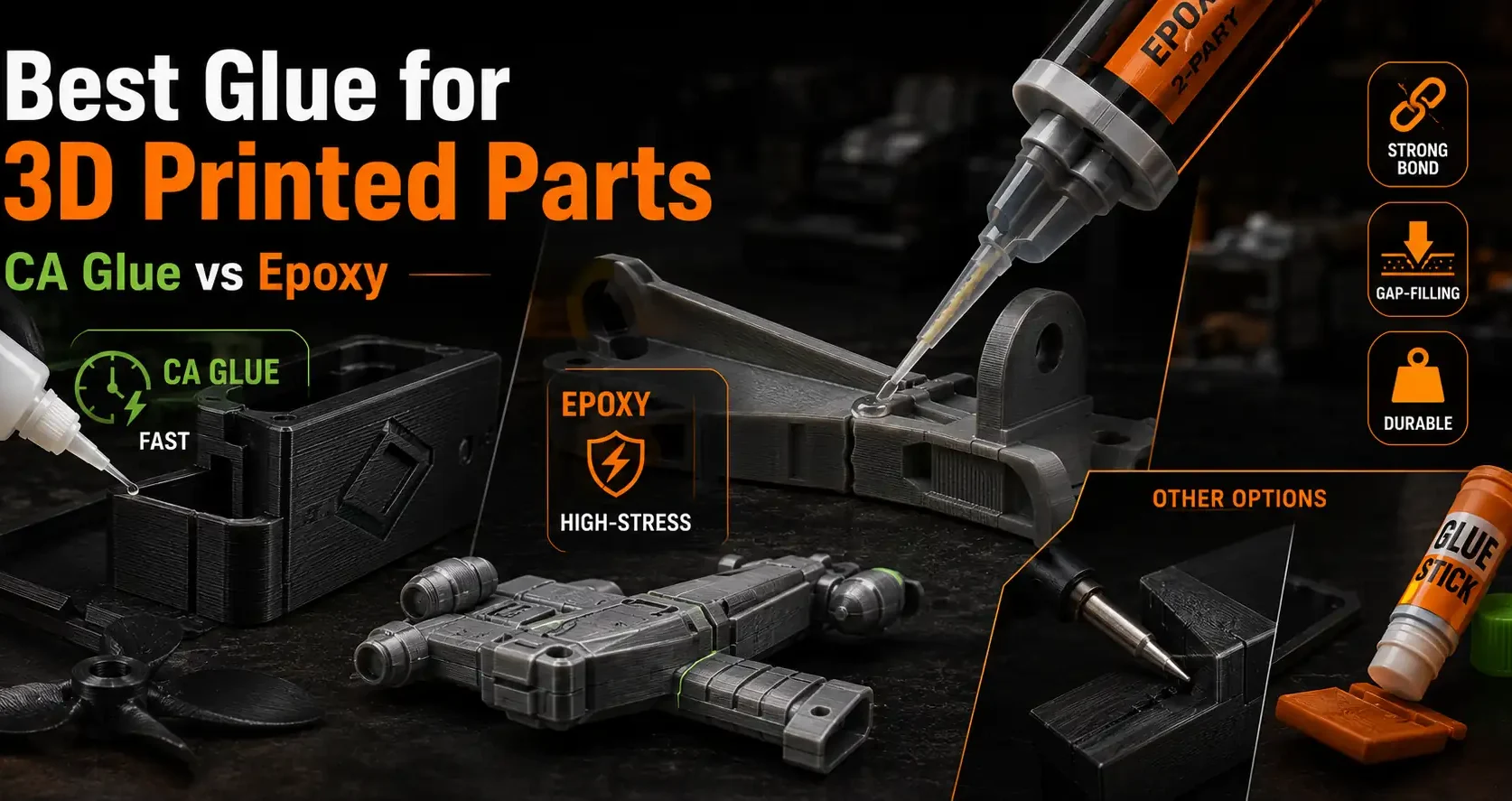
Gluing 3D printed parts together is one of the most common finishing tasks in FDM printing. Multi-part prints, repairs, and assemblies all need reliable adhesion between PLA, PETG, or other printed surfaces. The right adhesive depends on the joint size, the load it needs to carry, and how quickly you need it cured. Here is the honest ranking.
CA Glue (Super Glue): The Default Choice
Cyanoacrylate adhesive bonds PLA and PETG quickly and reliably. A thin application on both mating surfaces, held for 30-60 seconds, creates a bond that typically exceeds the strength of the surrounding plastic. For most cosplay prop assembly, deck box repairs, and multi-part model joins, CA glue is the right tool.
Use CA accelerator spray on joints that need to cure in seconds rather than minutes. Accelerator is particularly useful for awkward angles where you can’t hold pieces easily. Apply accelerator to one surface, CA to the other, bring together and the bond sets almost instantly.
For structural reinforcement: after the primary bond sets, run a thin bead of CA glue along the interior of the seam. This internal fillet adds significant strength without affecting the exterior appearance.
Two-Part Epoxy: For High-Stress Joints
Two-part epoxy provides a stronger, gap-filling bond compared to CA glue. It’s the right choice for structural joints that carry real mechanical load: hinges, weapon prop handles, large armour sections under stress during wear. Mix equal parts, apply to both surfaces, hold or clamp for the specified cure time (5 minutes for fast cure, 30 minutes for standard).
Epoxy’s gap-filling property handles slight surface imperfections that CA glue would leave as weak spots. On sanded or slightly mismatched join surfaces, epoxy is more reliable than CA.
Frequently Asked Questions: Best Glue for 3D Prints
What is the best glue for PLA 3D prints?
CA glue (super glue) for most applications: fast, strong, clean. Two-part epoxy for high-stress structural joints where gap-filling and maximum strength matter. Both work reliably on PLA when surfaces are clean and dry.
Does super glue work on PETG?
Yes, though adhesion to PETG is slightly lower than to PLA. For most hobby assembly tasks, CA glue provides adequate strength on PETG. For high-stress PETG joints, epoxy is more reliable. Clean PETG surfaces with IPA before gluing to remove any release agent or surface contaminants.
Can you weld 3D printed parts with a soldering iron?
Yes. Melting the plastic at join points with a soldering iron tip creates a fused bond by re-melting the material at both surfaces. Strong and permanent but requires careful technique to avoid cosmetic damage. Best suited for hidden internal joints where appearance doesn’t matter.