
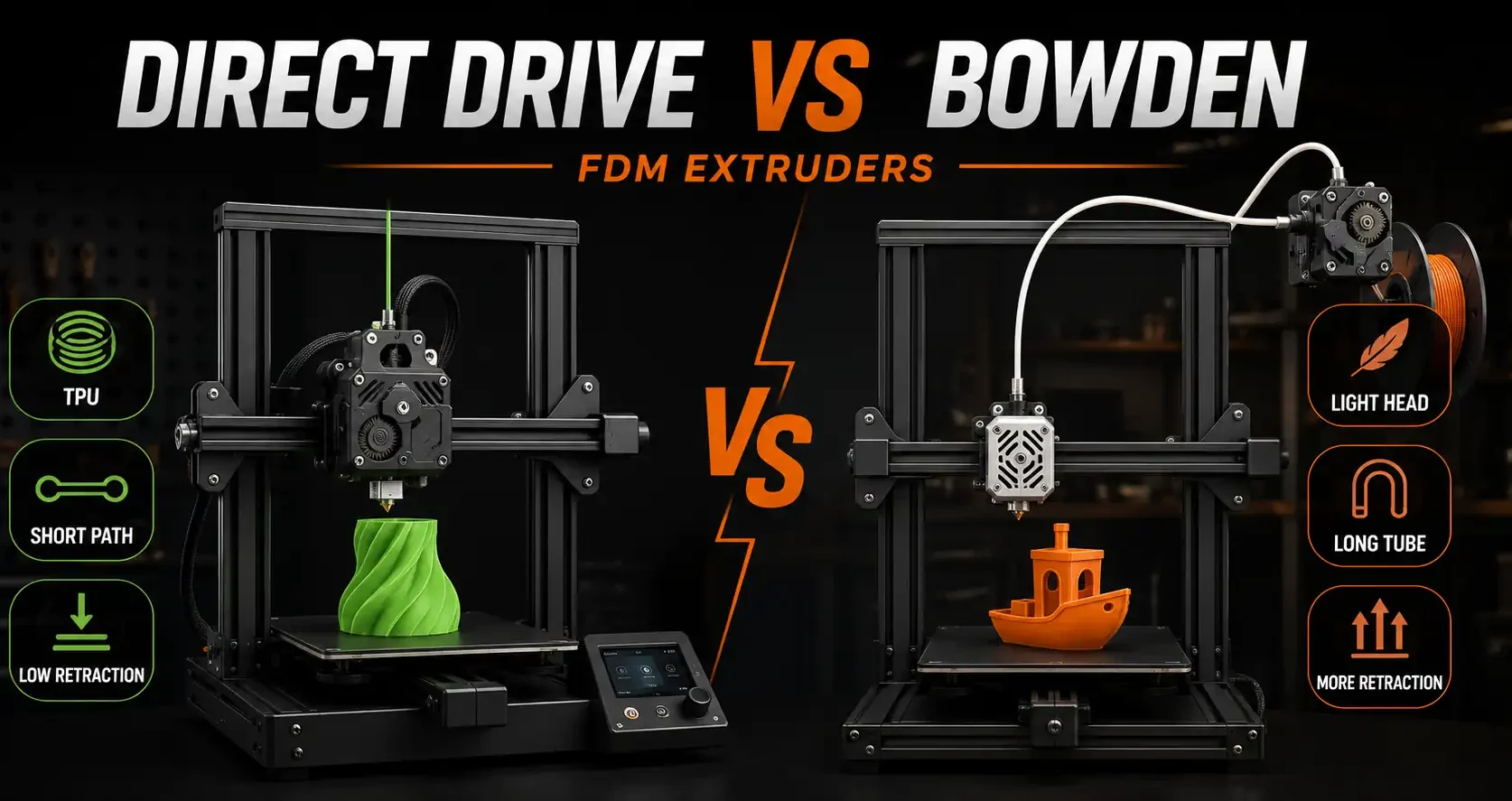
The extruder system on your 3D printer determines how filament gets pushed to the hotend. Two configurations dominate: direct drive (extruder on the print head, right above the hotend) and Bowden (extruder mounted remotely, filament fed through a PTFE tube). Both work well; they make different trade-offs that matter for specific use cases.
Direct Drive: Faster Response, Better for Flexibles
Direct drive places the extruder motor directly on the print head. The filament path from extruder gear to nozzle tip is only a few centimetres. Pressure changes from the extruder reach the nozzle almost instantly, enabling precise retraction control and better performance with flexible materials like TPU.
Most modern high-speed printers (Bambu Lab, Prusa MK4S) use direct drive. The downside is the added weight on the print head, which requires more rigid motion systems to print at high speeds without ringing artifacts. Modern printers solve this with input shaping firmware compensation.
Bowden: Lighter Print Head, Less Precise
Bowden systems place the extruder away from the print head, connected by a PTFE tube. The lighter print head allows faster movement with less ringing. However, the tube introduces compliance: retraction settings must be much higher (4-7mm vs 0.5-1mm for direct drive) to compensate for tube flex, and flexible filaments are notoriously difficult to feed reliably through the tube.
Older Creality Ender printers use Bowden. They print standard PLA and PETG well, but struggle with TPU and require careful retraction tuning. Many Bowden printer owners eventually convert to direct drive as an upgrade. The stringing guide covers retraction differences between the two systems.
Frequently Asked Questions: Direct Drive vs Bowden
Is direct drive better than Bowden for 3D printing?
For most hobbyist use cases in 2026, yes. Direct drive handles flexible materials better, needs less retraction tuning, and pairs well with the high-speed motion systems in modern printers. Bowden is still found on budget machines and works well for PLA and PETG if retraction is tuned correctly.
Can I print TPU with a Bowden extruder?
With difficulty. TPU’s flexibility makes it prone to buckling in the Bowden tube rather than feeding cleanly. Very slow speeds (15-25mm/s), minimal retraction (0-0.5mm), and a tight, well-maintained PTFE tube are required. Most makers recommend a direct drive printer or upgrade for reliable TPU printing.
Do all Bambu Lab printers use direct drive?
Yes. All current Bambu Lab printers (A1, A1 Mini, P1S, P1P, X1C) use direct drive extruders. This contributes to their reliable performance with flexible materials and their ability to run at high speeds with good retraction behavior.