
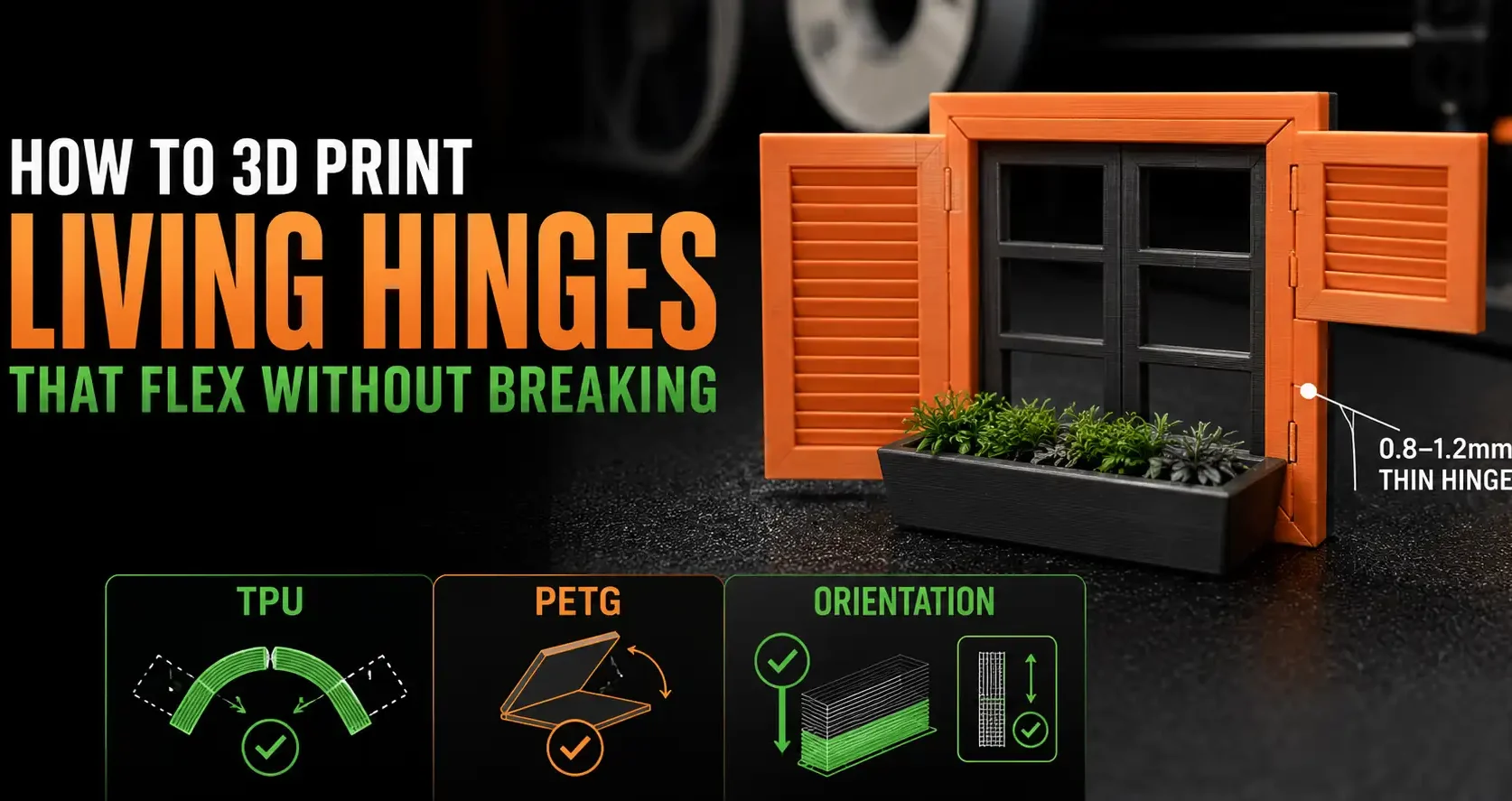
A living hinge is a thin flexible section of material that connects two rigid parts, allowing them to fold without a separate pivot mechanism. Printing them in FDM requires using the right material, the right thickness, and the right layer orientation. Done correctly, a living hinge in flexible filament or thin PETG flexes thousands of times without failure. Done incorrectly, it snaps on the first bend.
Material Choice: TPU is the Right Answer
TPU (thermoplastic polyurethane) is the correct material for living hinges that need to flex repeatedly over a long lifespan. Its rubber-like elasticity allows dramatic bending without stress concentration at the hinge. A TPU living hinge can flex 180 degrees thousands of times without fatigue failure. Print the hinge section in TPU using a direct drive printer at 20-30mm/s. Bowden setups struggle to feed TPU reliably.
PETG living hinges work for limited-cycle applications: lids that open and close occasionally rather than constantly. PETG is stiffer than TPU and eventually fatigues, but for a storage box that opens once a day, a well-designed PETG living hinge is entirely adequate. PLA living hinges are not recommended: PLA is too brittle and fatigues rapidly at flex points.
Geometry and Orientation
Living hinge thickness is the critical dimension. Too thick and the hinge is stiff and fatigues. Too thin and it has inadequate structural integrity. For TPU: 0.8-1.2mm. For PETG in a low-cycle application: 1.0-1.5mm. The hinge must print with layers running perpendicular to the bend axis (layers parallel to the hinge line). If layers run across the bend, the hinge will delaminate on first use regardless of material. Orient the model in the slicer so the hinge section prints horizontally with layer lines running along the hinge length.
Frequently Asked Questions: Living Hinges in 3D Printing
What filament is best for 3D printed living hinges?
TPU for long-life hinges. PETG for low-cycle applications. Never PLA for any living hinge intended for repeated use.
How thick should a 3D printed living hinge be?
0.8-1.2mm for TPU. 1.0-1.5mm for PETG. Thinner is more flexible but reduces structural integrity. Start at 1.0mm and test before finalizing.
Can I print a living hinge on a Bambu Lab printer?
Yes. Bambu Lab printers with direct drive handle TPU well at 20-30mm/s. Use a slow speed profile and disable pressure advance for TPU sections to prevent buckling in the extruder path.