
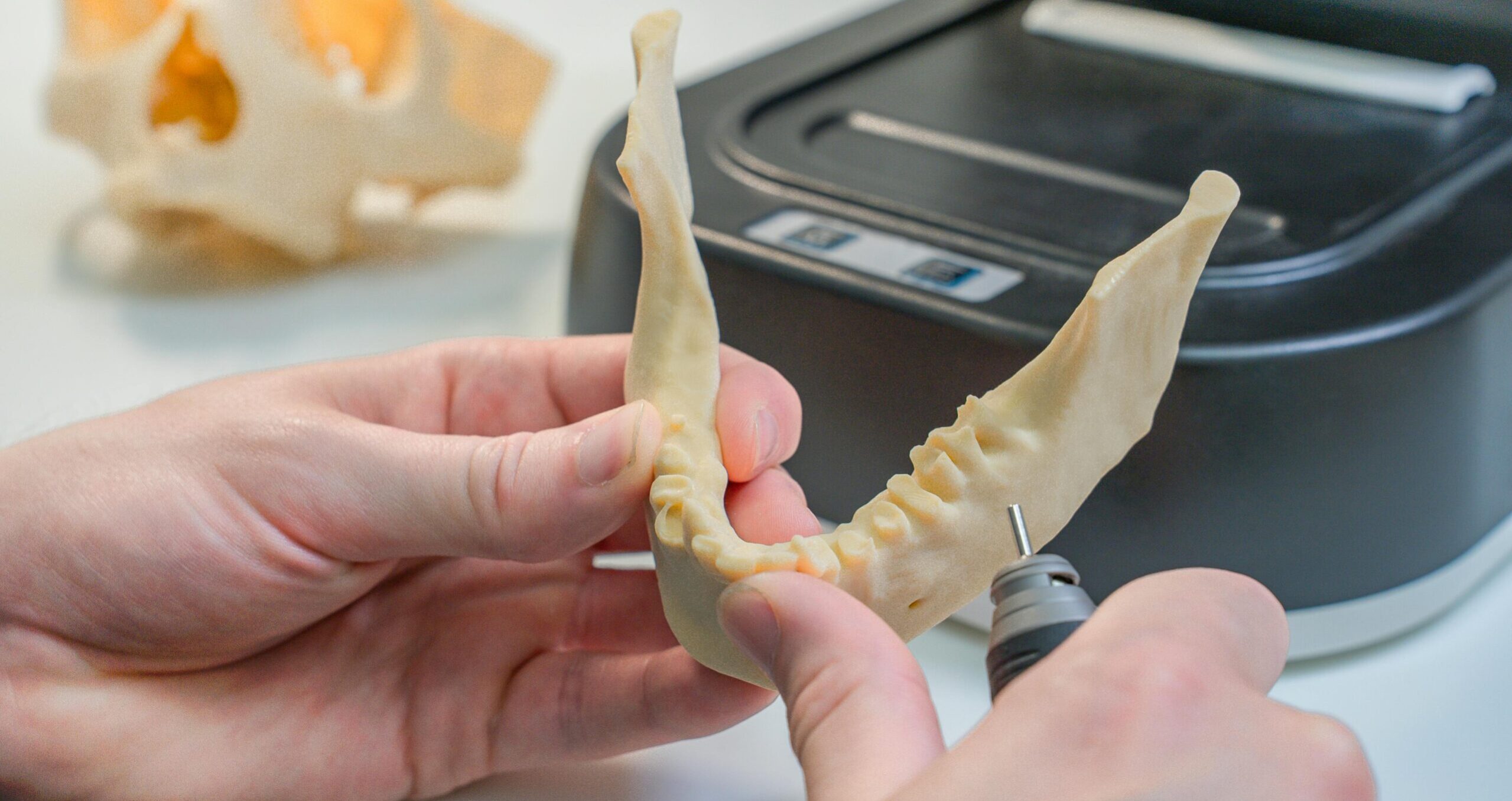
SLS is the 3D printing technology that produces parts with no visible layer lines, no support marks, and mechanical properties close to injection-molded plastic. It’s also the technology you almost certainly don’t own and probably won’t buy for home use. That’s not a limitation of the technology. SLS is genuinely impressive. It just operates in a different world from consumer FDM and resin. Understanding what it does, where it excels, and when it’s worth accessing through a print service is genuinely useful knowledge even if you never own the machine.
What Is SLS 3D Printing?
SLS stands for Selective Laser Sintering. Instead of melting filament through a nozzle or curing liquid resin with UV light, an SLS machine uses a high-power CO2 laser to selectively fuse powdered material layer by layer inside a heated powder bed.
The process works like this: a thin layer of powder is spread across the build surface. The laser scans the cross-section of the model at that layer height, fusing the powder particles where the model exists. A new layer of powder is spread on top. The laser scans the next cross-section. This repeats until the entire model is built, buried inside the surrounding unfused powder bed.
That powder bed is critical to understanding SLS’s unique advantage: it’s simultaneously the build material and the support structure. Because the part is surrounded by powder on all sides during printing, no support structures are generated or needed. Complex internal geometries, interlocking mechanisms, and deeply undercut features that would require extensive support in FDM or resin print without any support structure in SLS.
After printing, the build chamber cools, parts are excavated from the powder cake, and excess powder is blasted or brushed away. The unfused powder is sieved, refreshed with new powder at a defined ratio, and reused.
SLS vs FDM vs Resin: Complete Comparison
| Category | SLS | FDM | Resin (MSLA) |
|---|---|---|---|
| Entry cost | $5,000-$15,000 desktop; $100,000+ industrial | $200-$600 | $250-$500 |
| Supports needed | None. Powder is the support. | Often yes, depends on design | Usually yes |
| Surface finish | Matte, slightly grainy. No layer lines. | Visible layer lines | Smooth on exposed surfaces |
| Mechanical strength | Isotropic (equal all directions). PA12 ~50MPa tensile. | Anisotropic. Weaker perpendicular to layer lines. | Brittle. Strong in compression, weak in tension. |
| Primary materials | PA12, PA11, TPU powder. DMLS: titanium, stainless steel, aluminum. | PLA, PETG, ABS, ASA, TPU, PA, PC, CF | Photopolymer resin (standard, ABS-like, flexible, castable) |
| Color output | Grey/white natural. Can be dyed post-print. | Full color range by filament choice | Wide range of colored resins |
| Post-processing | Powder cleaning, bead blasting, optional dyeing | Minimal: remove from bed, optional supports | Wash + UV cure required. 30-60 min every batch. |
| Best for | Functional prototypes, complex interlocking geometry, medical/aerospace, end-use parts | Hobby, functional parts, large prints, everyday use | Miniatures, jewelry, dental, small-scale detail |
What SLS Is Actually Used For
SLS occupies the space between prototyping and low-volume production. It’s used when a part needs to be functional, geometrically complex, and available quickly — but the production volume doesn’t justify injection mold tooling.
Functional engineering prototypes. Parts that behave like the injection-molded final product for fit, function, and stress testing. PA12 nylon approximates production nylon properties closely enough that SLS prototypes give meaningful performance data.
Complex assemblies. Interlocking parts, living hinges, chain links, and jointed mechanisms that would require extensive support in FDM can be printed fully assembled in SLS. The chain link mechanisms and hinge assemblies that are challenging to produce cleanly in FDM come out of SLS in working condition.
Medical devices and orthotics. Custom-fit orthotics, prosthetic sockets, and surgical guides. SLS PA12 is biocompatible, sterilizable, and strong enough for these applications.
Small production runs. Consumer products at quantities of 10-1,000 units where injection mold tooling ($10,000-$50,000) doesn’t make economic sense but the part needs production-level quality.
Aerospace and defense components. Lightweight nylon and titanium parts for non-critical structural applications where design complexity would be impossible with traditional manufacturing.
DMLS and Metal SLS
Direct Metal Laser Sintering (DMLS) — also called SLM (Selective Laser Melting) or LPBF (Laser Powder Bed Fusion) — applies the SLS principle to metal powder. The laser fully melts (rather than merely sintering) metal powder particles, producing parts in titanium, stainless steel, aluminum, cobalt-chrome, and specialty alloys.
DMLS metal parts are used in aerospace for engine components, in medical for orthopedic implants, and in motorsports for geometry that’s impossible to machine conventionally. Part cost per piece runs $50-$500+ depending on material and geometry.
For hobbyists, DMLS is relevant only through print services. If you need a functional metal part with complex internal geometry — a custom tool holder, a structural bracket for a specialized application — DMLS from a service bureau is accessible. But it’s overkill for anything in the hobby space.
SLS vs HP Multi Jet Fusion (MJF)
HP’s Multi Jet Fusion (MJF) is a competing powder-bed technology that’s been taking market share from SLS in prototyping and small-batch production since the mid-2010s. It’s worth knowing the distinction when ordering from print services.
MJF uses inkjet heads to deposit fusing and detailing agents across a powder bed, which is then exposed to heat to fuse the material. It’s faster than SLS for many part geometries and produces slightly better dimensional accuracy. The most common material is also PA12.
For a maker ordering a functional nylon part from Xometry, Craftcloud, or a similar service, SLS and MJF produce parts with very similar properties in PA12. MJF often produces slightly more precise dimensions and a slightly finer surface texture. Cost difference is marginal. Most services let you specify the technology.
Accessing SLS Without Owning a Machine
For anyone who needs a one-off functional part with SLS properties, print services are the practical answer. Upload your file, select SLS nylon, and receive the finished part.
Service options:
- Xometry — US-based manufacturing marketplace. Quotes instantly, delivers fast. Strong for one-off prototypes. Typical SLS PA12 part: $30-$100.
- Craftcloud — Aggregates quotes from multiple print services globally. Good for comparing prices.
- Shapeways — Direct-to-consumer 3D printing service. Longer in the consumer space. Good for small orders.
- Protolabs — Professional manufacturing services including SLS, CNC, injection molding. Higher cost, faster turnaround, professional tolerances.
When does the cost make sense? When your FDM part keeps failing at a specific joint or under a specific load, and you’ve exhausted the wall count and infill options. When you need a part that’s genuinely isotropic. When the geometry is too complex for FDM without extensive support. For those specific cases, $40-$80 for an SLS part is a practical engineering decision.
SLS Surface Finish and Coloring
Fresh SLS parts have a characteristic slightly grainy, matte surface. No layer lines are visible because the sintering process partially melts adjacent powder particles, creating a continuous surface. The texture is similar to a fine sandblasted metal surface.
Bead blasting: Most commercial SLS parts are bead blasted after powder removal to produce a consistent, smooth matte finish. The difference between as-printed and bead-blasted is significant and most services include it.
Dyeing: White or grey PA12 parts can be dyed after printing. The porous surface absorbs dye deeply and evenly. Commercial dyeing services offer a wide color range. DIY dyeing with fabric dye (iDye Poly is popular) produces respectable results on PA12 at home. This is how colored SLS consumer products are typically finished.
Spray painting: SLS parts accept primer and paint well. The slight porosity of the surface actually helps paint adhesion. Sand lightly with 220 grit, prime, and paint as you would an FDM part.
Vapor smoothing: Some commercial services offer vapor smoothing with chemical agents that partially melt the surface to produce a glossy, layer-line-free result. Improves appearance and reduces moisture absorption in the final part.
Desktop SLS in 2026: The Consumer Market
The consumer SLS price floor has dropped significantly. Sinterit Lisa X ($6,500), Sintratec S2, and Formlabs Fuse 1+ ($18,500) now bring SLS into ranges that professional studios, design agencies, and well-funded makerspaces can consider.
For an individual hobbyist, the barriers remain significant: initial cost, powder handling infrastructure (sieving, storage, ventilation), safety considerations with fine powder particles, and the learning curve of a more complex process. The powder management alone — recovering, sieving, refreshing, and storing 5-25kg of fine powder — requires a dedicated workspace and process discipline that most hobbyists won’t want to manage.
Worth watching through the end of the decade. SLS is following the same cost curve that brought FDM from $10,000 machines in 2010 to $300 machines today. The $500-$1,000 SLS printer is not here yet, but it’s coming.
Frequently Asked Questions: SLS 3D Printing
What does SLS stand for?
Selective Laser Sintering. A high-power CO2 laser selectively fuses (sinters) powdered material, typically nylon, layer by layer inside a heated powder bed. The surrounding unfused powder supports the part during printing, eliminating the need for support structures entirely.
Is SLS better than FDM?
For specific applications: yes. SLS produces parts that are equally strong in all directions (isotropic), with no layer-line weakness, no support marks, and excellent nylon properties. For typical hobby applications (large prints, props, deck boxes, dollhouse furniture), FDM is the better practical choice: dramatically cheaper, more material variety, simpler workflow, and large build volumes that SLS doesn’t match at consumer price points.
Why can’t SLS print in color?
The powder sintering process produces white or grey nylon naturally. Adding colorant to the powder interferes with the sintering chemistry. Parts are colored after printing through dyeing, painting, or vapor smoothing — not during the print. Some newer multi-color SLS systems exist at industrial scale, but they’re not commercially accessible for hobbyists.
What is the difference between SLS and DMLS?
SLS typically refers to polymer powder (nylon, TPU) sintered with a CO2 laser. DMLS (Direct Metal Laser Sintering) applies the same principle to metal powder (titanium, stainless steel, aluminum, cobalt-chrome), fully melting rather than just sintering the particles. DMLS produces dense metal parts used in aerospace, medical, and motorsports applications. Both are powder-bed laser fusion processes, but the materials, lasers, build environments, and costs differ substantially.
Can I get an SLS print made without buying the machine?
Yes. Xometry, Craftcloud, Shapeways, and Protolabs all accept SLS orders. Upload your STL file, select material (usually PA12 nylon), and receive a finished part. For one-off functional parts that need SLS properties, this is the practical approach. Cost is typically $30-$100 for a fist-sized part.
Does SLS need supports?
No. This is one of SLS’s defining advantages. The unfused powder surrounding the part during printing acts as the support structure. Complex overhangs, interlocking parts, internal channels, and deeply undercut geometry all print without any support structure or post-print support removal.
What is the surface finish of SLS parts like?
Matte, slightly grainy texture with no visible layer lines. Similar in appearance to a sandblasted surface. Most commercial SLS services bead blast parts after printing to produce a consistent smooth matte finish. The porosity of the surface actually helps with paint and dye adhesion compared to smooth injection-molded surfaces.