They Work on Different Printers
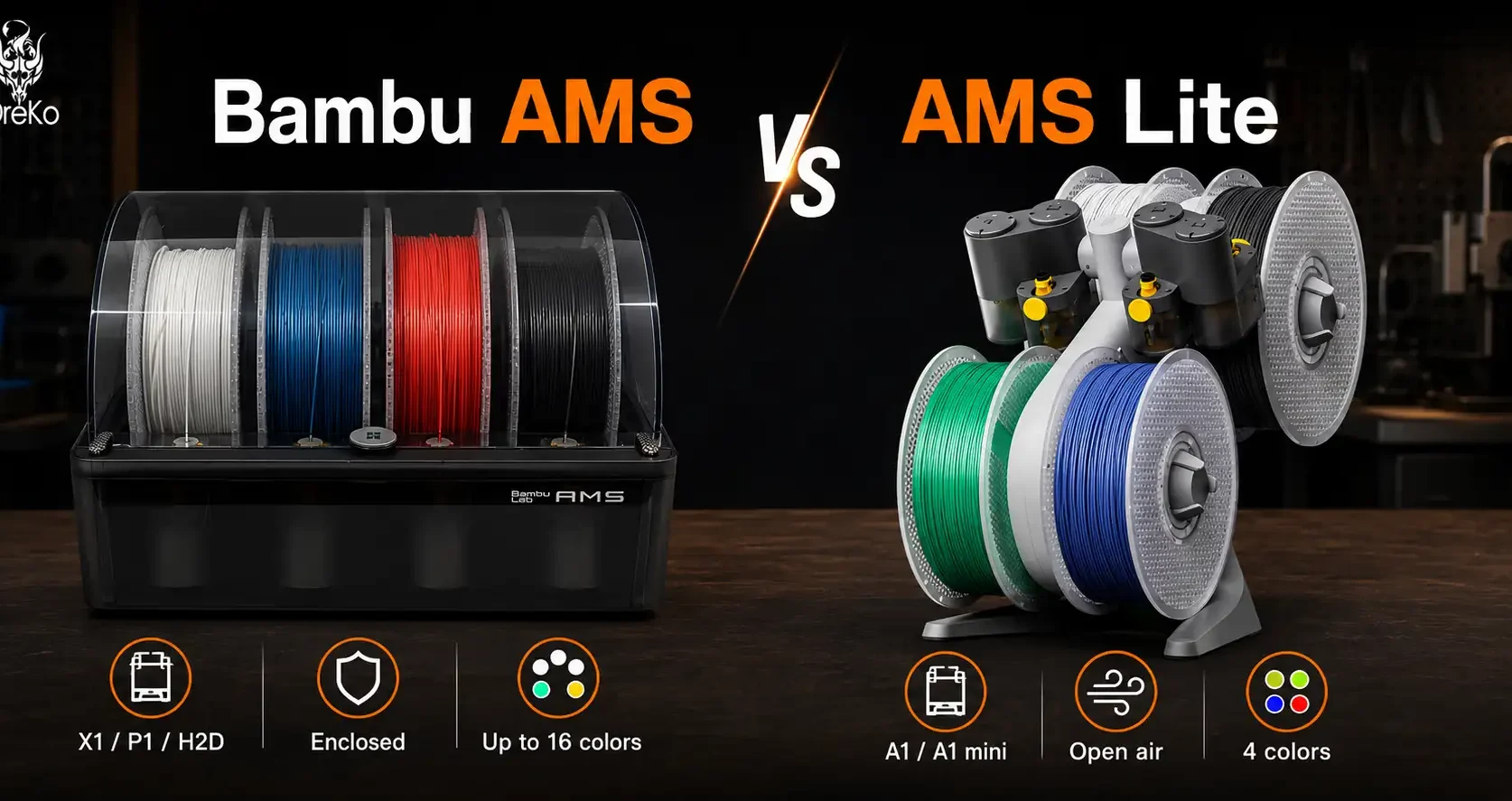
The AMS and AMS Lite are not two versions of the same product where you pick the better one. They are designed for completely different Bambu Lab printers, and the two systems are not compatible with each other. Which one you need is determined by the printer you own or plan to buy.
This is the thing most comparisons skip past. So let’s start there.
What Is the AMS Lite
The AMS Lite is the multi-material unit built for the Bambu Lab A1, A1 Mini, and A2L. It holds up to four 250g filament spools and handles automatic color changes during a print. When the slicer calls for a color switch, it cuts the current filament, retracts it, and loads the next one. No manual swapping.
The AMS Lite supports PLA, PETG, and TPU. It works well with Bambu’s own filaments and most standard third-party PLA. The open-air design means moisture-sensitive filaments like nylon can cause feeding issues over time. A desiccant in the spool holders keeps PLA printing reliably in humid climates.
The A1 Mini supports one AMS Lite: four colors maximum. The full-size A1 can connect two AMS Lite units for up to eight colors.
What Is the AMS
The AMS (Automatic Material System) is the full-featured unit designed for Bambu’s enclosed CoreXY printers: the X1C, X1E, P1S, P1P, and H2D. It also holds four spools per unit but uses an enclosed housing with a built-in desiccant system that actively protects filament from humidity. The mechanism handles a wider range of materials including ABS, ASA, PA, and PC in addition to PLA and PETG.
Up to four AMS units can be chained together for 16-color printing. Each unit takes full 1kg spools rather than the 250g spools the AMS Lite uses.
If you want more than eight colors, or need to print engineering materials reliably, the full AMS is the only option in the Bambu ecosystem.
Side-by-Side Comparison
| AMS Lite | AMS | |
| Compatible printers | A1, A1 Mini, A2L | X1C, X1E, P1S, P1P, H2D |
| Spool size | 250g max | 1kg |
| Colors (A1 Mini) | 4 max (1 unit) | N/A |
| Colors (A1 / A2L) | 8 max (2 units) | N/A |
| Colors (X1C / P1S) | N/A | 16 max (4 units) |
| Enclosure | Open air | Enclosed + desiccant |
| Materials | PLA, PETG, TPU | PLA, PETG, TPU, ABS, ASA, PA, PC |
| Price (standalone) | ~$149 | ~$349 |
Which One Do You Need
This is simpler than it looks.
If you have an A1 Mini, A1, or A2L: the AMS Lite is your only compatible option. The full AMS does not work with those printers.
If you have an X1C, P1S, P1P, X1E, or H2D: you need the AMS. The AMS Lite is not compatible with those printers.
They are not interchangeable. You cannot upgrade from an AMS Lite to a full AMS without also switching your printer.
Is the AMS Lite a Downgrade?
For most hobby printing, no. Four colors covers the majority of multi-color work: two-tone deck box caps, logo inserts, color-accent miniatures, painted cosplay parts. The printing experience is the same as the full AMS — automatic color changes, purge tower management, all handled by Bambu Studio.
The full AMS has a clear advantage in three areas: engineering materials (ABS, ASA, PA), projects needing more than eight colors, and environments where active filament humidity control matters. If those are not your use cases, the AMS Lite handles everything you need.
Frequently Asked Questions
What is the difference between AMS and AMS Lite?
AMS: enclosed with desiccant humidity control, faster swaps, supports engineering materials, expandable to 16 colors, works with X1C and P1 series. AMS Lite: open-top, no active humidity control, supports PLA and PETG well, ships with A1, A1 Mini, and A2L. Both produce identical multi-color output for standard PLA projects.
Is the AMS Lite good enough for hobby printing?
Yes. For deck boxes, cosplay props, dollhouse parts, and other PLA hobby projects, the AMS Lite produces identical multi-color output to the full AMS. The humidity concern matters more for engineering material use than for typical hobby printing.
Can I upgrade from AMS Lite to full AMS?
The full AMS works with X1C and P1 series printers only. The A1, A1 Mini, and A2L use AMS Lite exclusively. You cannot swap between them without changing your printer.
Where the A2L Fits
The Bambu Lab A2L has since launched as the larger-format addition to the A-series lineup, and it uses AMS Lite exactly like the A1 and A1 Mini. If you’re deciding between A-series printers, the AMS setup is the same across all three: up to two AMS Lite units, eight colors, PLA/PETG/TPU support. The build volume is the only thing that changes between them, not the color system.
For the full rundown on the A2L itself, read the Bambu Lab A2L first look. For the current A1 Mini, read the Bambu Lab A1 Mini review.