
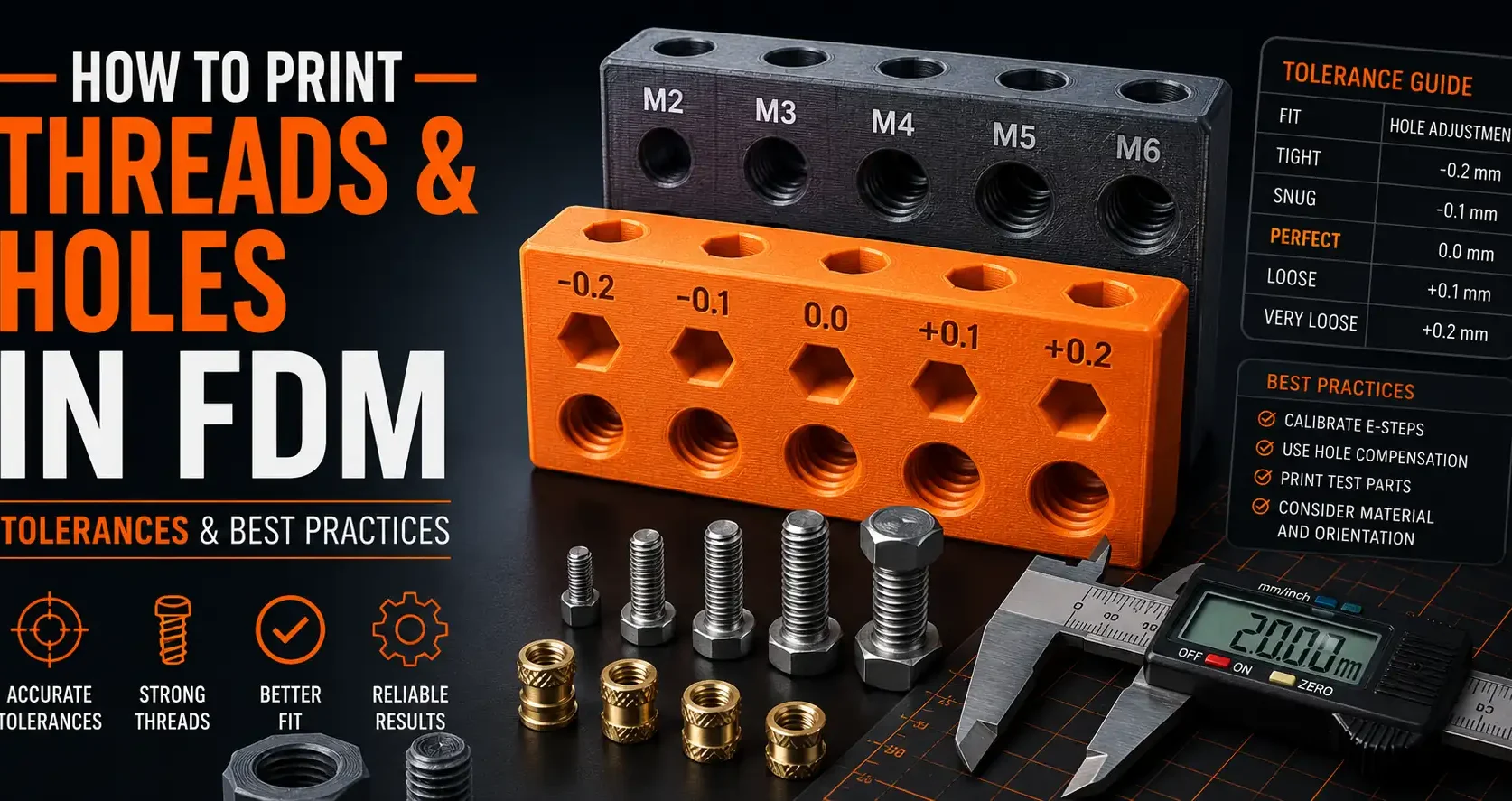
Printing threads and precise holes in FDM requires accounting for how FDM slightly under-sizes holes and the specific design constraints that make threads printable versus fragile. Get the tolerances right and your printed threads work on the first try. Get them wrong and you have a part that either won’t thread or strips after two uses.
Hole Sizing: The FDM Shrinkage Problem
FDM prints holes slightly smaller than designed. A 5.0mm diameter hole in your model typically prints 4.6-4.8mm in practice due to material shrinkage and how extruded lines fill curved geometry. For any hole where dimension matters (screw clearance, press-fit pin, bearing seat), design the hole 0.2-0.4mm larger than your target and test with a calibration print.
Quick reference: for an M3 screw clearance hole, design 3.4mm. For an M5 nut trap (hex recess), design 0.3mm larger than the flat-to-flat dimension. Print a calibration test with 5-6 hole sizes in 0.1mm increments to find the exact offset for your specific printer and filament combination.
Printed Threads: When They Work and When They Don’t
FDM-printed threads work reliably for coarse threads (M5 and larger, or custom threads with pitch of 2mm or more) printed vertically so the thread profile prints on the XY plane. Fine threads (M3 and smaller) are marginal at best on a 0.4mm nozzle because the thread profile is close to minimum feature size. Heat-set inserts (brass threaded inserts pressed into the plastic with a soldering iron) are a better solution for fine threaded connections in FDM parts.
For coarse printed threads, add 0.3-0.5mm clearance on mating threaded parts. The thread surfaces won’t be as smooth as metal, so a small amount of extra clearance prevents binding.
Frequently Asked Questions: Printing Threads and Holes
Why are my 3D printed holes too small?
FDM material shrinks slightly as it cools, and extruded lines don’t perfectly follow a circular path at small diameters. Design holes 0.2-0.4mm larger than your target and verify with a calibration print to find your specific printer’s offset.
Can you 3D print screw threads?
Yes, reliably for M5 and larger with coarse pitch. M3 and smaller printed threads tend to be weak and imprecise at 0.4mm nozzle diameter. Heat-set brass inserts are a more reliable solution for fine threaded connections.
What is a heat-set insert?
A brass threaded insert that’s pressed into a printed hole using a soldering iron. The heat softens the surrounding plastic, which flows around the knurled exterior of the insert and solidifies to hold it permanently. The result is a metal-threaded hole that withstands repeated assembly far better than a printed thread.