
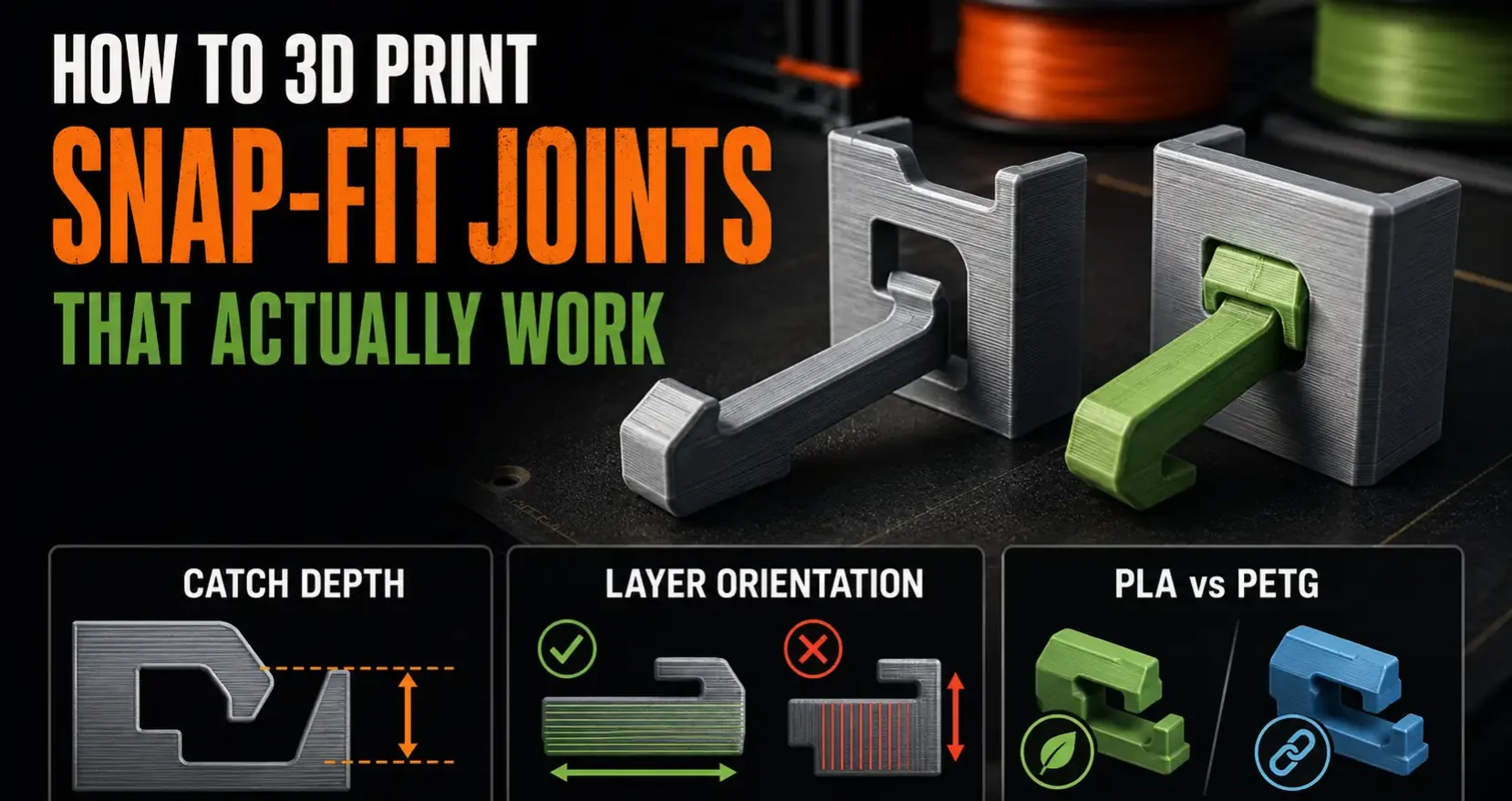
Snap-fit joints are connections that flex slightly on assembly and lock into place without screws, glue, or hardware. They are one of the most satisfying design features in FDM printing when they work correctly and one of the most frustrating when they don’t. Getting snap-fits right requires understanding the tolerance windows that make them click without cracking.
The Basic Snap-Fit: How It Works
A cantilever snap-fit has a flexible arm with a catch feature at the end. When assembled, the arm deflects as the catch passes over a lip, then springs back to lock. The deflection must be within the material’s elastic range: too much deflection and the arm cracks. Too little and the snap doesn’t engage. PLA is stiffer and more brittle than PETG, which means PLA snap-fits need shallower catch geometry (less deflection required) while PETG can handle more aggressive snaps.
Typical working catch depth for PLA: 0.3-0.5mm. For PETG: 0.5-1.0mm. Arm thickness for a reliable PLA snap at 20mm length: 1.5-2.0mm. Shorter arms need proportionally thinner sections to achieve the same deflection.
Orientation and Layer Lines
The most critical design consideration for printed snap-fits is layer line orientation. Snap-fit arms flex perpendicular to the layer plane. If the layers run along the arm’s length, bending stresses delaminate the layers and the snap breaks after a few uses. Print snap-fit arms so the layers run perpendicular to the bending direction: the arm bends along the layer plane, not across it. This is why snap-fit arm geometry sometimes requires a specific print orientation or a rotated component to work correctly.
PETG handles layer-direction bending better than PLA due to its higher impact toughness, which is one reason PETG is preferred for functional snap-fit parts. More on material choice at the PLA vs PETG guide.
Frequently Asked Questions: Snap-Fit Joints
How tight should a snap-fit be in FDM printing?
Tight enough to hold under normal use loads without unintentional release, loose enough to assemble without excessive force that risks snapping the arm. Start with 0.3mm catch depth for PLA and increase if the connection is too loose. Print a small test snap before committing to a full model.
Why does my 3D printed snap-fit keep breaking?
Most snap-fit breakage is delamination along layer lines (print orientation issue) or catch depth too aggressive for the material’s flexibility. Check that the arm bends along the layer plane, not across it, and reduce catch depth by 0.1mm if breakage occurs on first assembly.
Is PLA or PETG better for snap-fits?
PETG. Its higher toughness and greater flexibility allow more deflection before failure. PLA snap-fits work for light-duty applications with conservative catch depth but crack more readily under repeated cycling. For snap-fits that will be opened and closed regularly, PETG is the right material.