
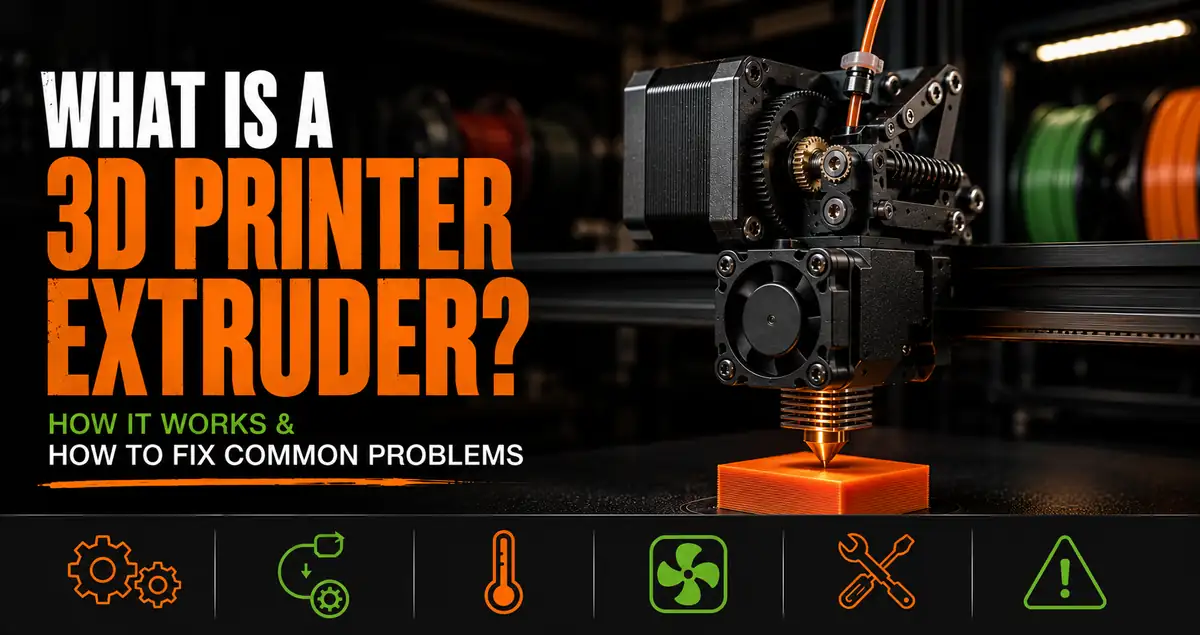
The extruder is the motor-driven mechanism that feeds filament from the spool into the hot end. It is separate from the hot end (which melts the plastic) but works in coordination with it. Understanding the extruder helps you diagnose a significant category of print problems, from underextrusion and grinding to layer separation and inconsistent lines.
How an Extruder Works
A typical FDM extruder uses a stepper motor to drive a toothed gear that grips the filament. As the motor turns, the gear bites into the filament surface and pushes it forward toward the hot end, or pulls it back for retraction. A spring-loaded idler arm presses the filament against the drive gear from the other side to maintain consistent grip.
The extruder motor receives commands from the printer’s control board in the form of precise step counts. Each step moves the filament a defined distance. The slicer calculates exactly how many steps are needed to extrude the correct volume of plastic for each line at each layer height and width. This precise coordination between extruder motion and print head movement is what makes dimensional accuracy possible.
Common Extruder Problems
Extruder clicking or skipping: the most common extruder problem. The motor is trying to push filament but something is resisting. Causes include a partial nozzle clog, print temperature too low for the material, or print speed exceeding the extruder’s ability to keep up. Fix: cold pull to clear clog, raise temperature 5°C, reduce speed. Full diagnosis in the under-extrusion guide.
Filament grinding: the drive gear chews a groove into the filament instead of pushing it. Usually indicates a severe clog or extremely high resistance. The damaged filament section loses diameter and the extruder loses grip entirely. Cut off the damaged filament section, clear the clog, and reload before continuing.
Extruder vs hot end distinction: if you hear clicking from the extruder, the problem is upstream (clog, temperature, speed). If you see visual extrusion problems but no clicking, the problem may be in the hot end (heat creep, partial melt zone issue). Location of symptoms guides diagnosis.
Frequently Asked Questions: 3D Printer Extruder
What is the difference between the extruder and the hot end?
The extruder is the motor-and-gear assembly that feeds filament. The hot end is the heating assembly that melts it. They work together but are separate components. The extruder pushes filament; the hot end melts and deposits it. Problems with each produce different symptoms.
Why is my extruder clicking during printing?
The extruder motor is skipping steps because it can’t push filament at the rate the slicer is requesting. Most commonly caused by a partial clog in the nozzle, print temperature too low, or print speed too high. Start with a cold pull to clear the nozzle, then raise temperature 5°C.
What is an E-step calibration?
E-steps (extruder steps) define how many motor steps equal exactly 1mm of filament movement. A correctly calibrated extruder deposits exactly the volume of plastic the slicer calculates. On Bambu Lab printers, flow calibration handles this automatically. On manually configured printers, E-step calibration is done through the firmware settings.