
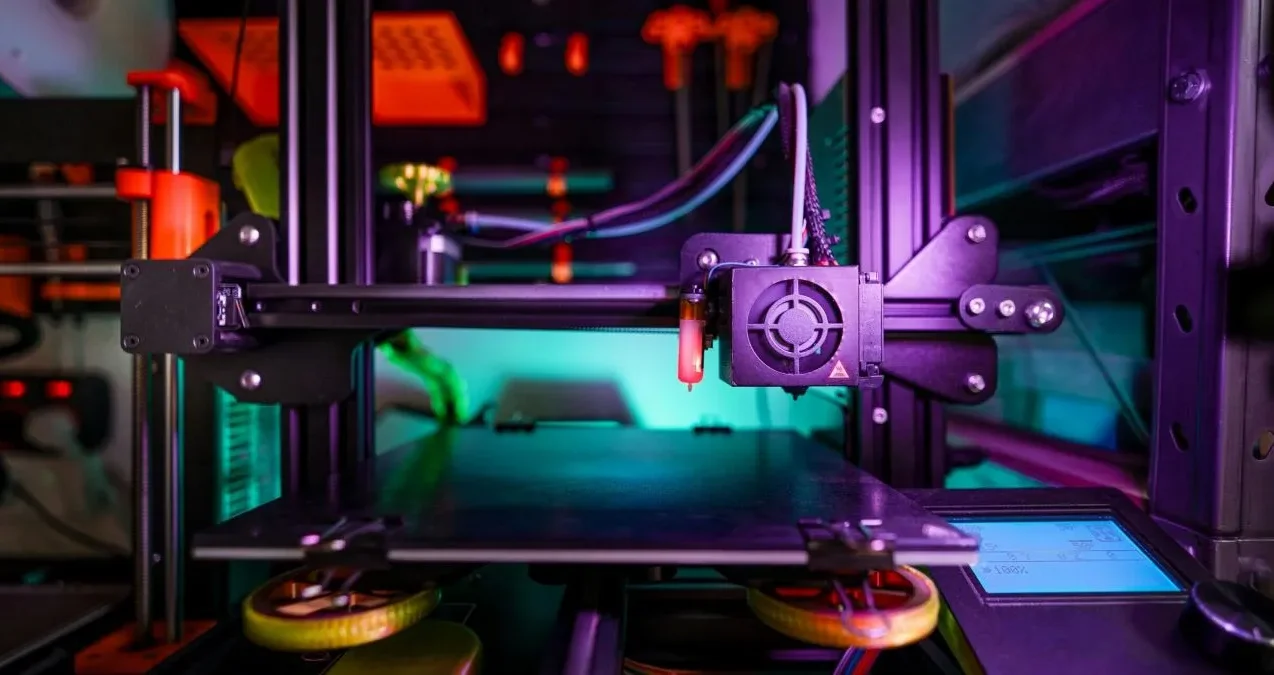
FDM stands for Fused Deposition Modeling. It’s the most common type of consumer 3D printing and the technology behind nearly every desktop printer sold today. An FDM printer melts a plastic filament and deposits it in precise layers from the bottom up until a complete 3D object is built. That’s the whole process in one sentence.
How FDM Printing Works, Step by Step
A spool of plastic filament feeds into the printer’s hot end, where a heater block melts it to the correct temperature for the material (190-220°C for PLA, for example). The melted plastic is pushed through a nozzle, which deposits it as a precise line onto the build surface. The print head moves in X and Y to trace each layer’s cross-section. Once a layer is complete, the bed or gantry moves in Z by the layer height (typically 0.2mm) and the next layer begins.
Each layer bonds to the one below it through heat. The process repeats until the full object is built. A simple phone stand might take 200-400 layers. A complex prop piece might take 2,000+. Each layer is typically 0.12-0.3mm thick depending on your quality setting.
More on how this connects to G-code and slicer software at the how 3D printing works guide.
FDM vs Other 3D Printing Technologies
FDM is one of three main consumer 3D printing technologies. Resin (MSLA) uses UV light to cure liquid photopolymer layer by layer, producing finer detail at small scales but requiring chemical handling. SLS (Selective Laser Sintering) uses a laser to sinter powder, producing the strongest parts, but remains expensive for consumer use.
For most hobbyists, FDM is the practical choice: lower cost, wide material range, no hazardous chemicals, and large build volumes. The full comparison is at the resin vs FDM guide.
What FDM Can and Can’t Do
FDM excels at: functional parts, large objects, colorful prints, rapid iteration, and anything where build volume matters. It handles PLA, PETG, ABS, ASA, TPU, and dozens of specialty materials.
FDM’s limits: layer lines are visible on curved surfaces, minimum feature size is limited by nozzle diameter (typically 0.4mm), and very fine detail at small scales (under 30mm) doesn’t match resin quality. For most hobby printing, these limits don’t matter.
Frequently Asked Questions: FDM 3D Printing
What does FDM stand for in 3D printing?
Fused Deposition Modeling. The term describes the core process: plastic filament is fused (melted) and deposited (placed) in a precise pattern to build a 3D object layer by layer.
Is FDM the same as FFF?
Yes. FFF (Fused Filament Fabrication) is the same technology under a different name. FDM is trademarked by Stratasys; FFF is the generic term. In practice, both describe identical processes and the terms are used interchangeably in the maker community.
What materials can FDM printers use?
PLA, PETG, ABS, ASA, TPU, nylon, polycarbonate, carbon fiber composites, and many specialty blends including silk, matte, glow-in-the-dark, and metal-filled variants. Material choice depends on what properties the finished part needs: strength, heat resistance, flexibility, or surface finish.